This past Sunday I participated in a discussion group. The leader asked. “Do you believe the death and resurrection of Jesus actually happened?”
The consensus within the group was yes. If one can’t believe the death and resurrection, what point is there in being a Christian?
I suggested that the death and resurrection were symbolic. I used a story from my book The Ecumenical Affair, to illustrate how God spoke to Moses through a burning bush.
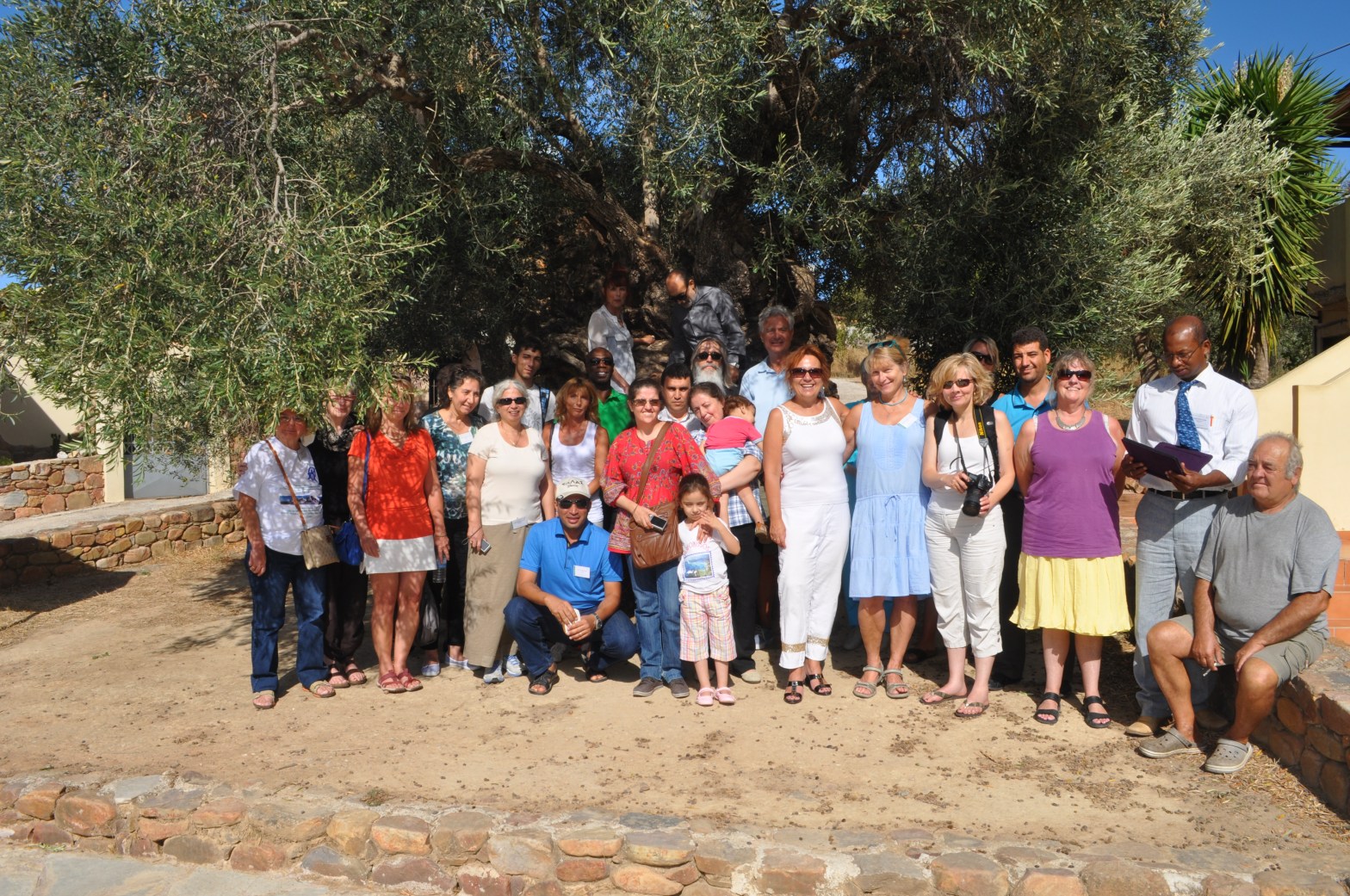
I recounted the story of how the Woman defended the idea that the bush was not an actual bush to two prominent visitors attending the 6th Assembly of the World Council of Churches. At Noon that day, the Greek a prominent Greek philosopher and member of the Ecumenical Patriarchal Staff had invited the Woman to dine with him that evening. Also, invited to the Greek’s table that evening was his friend, a Roman Catholic father from the Vatican Staff.
The Father asked the Woman. What do you think of all those protestors denouncing this Assembly?
The Woman replied. “Oh, they’re just a bunch of Pentecostals who take the Bible literally.”
The Father says. “What do you mean? I take the Bible literally.”
The Woman says. “They don’t see the metaphors…take the burning bush for instance. Do you honestly believe that Moses actually saw and spoke to a burning bush?”
The Father replies. “Yes, if Moses said he spoke with a burning bush, I believe him.”
The more the Woman protested and offered examples of metaphors, the more excited she got. When she finally said. “A bush could be a sage…”
A Woman in Sunday’s group interjected. “What has a sage got to do with the burning bush?”
I replied, “A sage is a small bush and it is also a wise person and as I, the Woman of the story made this point, the two men suddenly started to speak rapidly and excitedly in Greek.”
The interjector continued. “What has that got to do with a burning bush?”
I replied. “As the three of us discussed whether or not Moses actually heard God’s voice calling his name as he spoke with the burning bush, the burning bush leapt right out of the pages of scripture and appeared to me. The three persons on fire for their faith were that bush, a meta metaphor—not merely a metaphor, something more.”
The group looked skeptical.
Another offered. “I think Moses saw an actual bush with the sunlight coming down in such a way as to make it look like it was actually on fire.”
The Leader then asked. “What do others think. Was the death and resurrection meta metaphorical?”
One by one, people insisted the death and resurrection had to be more than a metaphor. It had to have happened because people have been believing for 2000 years.
People talked about near death experiences. I mentioned that my late husband, their former minister, explained the resurrection of the Risen Christ as a spiritual one as opposed to a physical, bodily resurrection.
I said. “My late husband and I argued about this point often. I always took the stance that the resurrection had to be a physical one because Thomas demanded proof. He wanted to touch Jesus and put his fingers in the nail prints and his hand in his wounded side.”
The discussion continued with people remembering times when loved ones had died or nearly died. The group’s experience with death was not one of fear. They felt at peace with death because of the Gospel testimony and the two-thousand-year Christian belief that God raised Jesus from the dead.
I went home thinking. “This is not good enough. Christians need to probe the enigma, the mystery, of who Jesus is and how and why Jesus the Nazarene died. The Apostle Paul is adamant. We have been crucified with Christ and we shall rise with him (Romans 6:6). More importantly, Paul says God raised Jesus from the dead so that God’s children may be knit together in love, “comforted with the full assurance of understanding, that they may acknowledge the mystery of God, and of the Father, and of Christ” (Colossians 2:2 KJV).
So, on Monday I started to write this blog. I started with Sunday’s Gospel reading: John 20:19-29.
In this reading, Jesus breathes on the disciples and says. “Receive the Holy Spirit.” Thomas also known as the Twin says to the disciples. “Unless I see the nail marks in his hands and put my finger where the nails were, and put my hand into his side, I will not believe.” A week later … Jesus stands among them and says, “Peace be with you!” Then he says to Thomas, “Put your finger here; see my hands. Reach out your hand and put it into my side. Stop doubting and believe.” Thomas says to him, My Lord and my God!”
I asked myself. Why? Why would Thomas, also known as the Twin need proof?
So, I turned to the alternate reading for Sunday. It came from the Book of Acts 2:14a, 22-32
Here is what I was looking for. In this passage, Peter stands up, raises his voice and confirms the resurrection. He says. “Jesus of Nazareth was a man certified by God to you by miracles, wonders, and signs, which God did among you through Him…He was handed over by God’s set plan … and you, by the hands of the lawless, put Him to death by nailing Him to the cross. ”
The Rock stands up! Think about this. The Rock full of faith and personal conviction tells the disciples that Jesus of Nazareth was nailed to a cross and put to death with the help of the disciples and lawless people.
Think about the Cross.
Is the Cross a stake that the Romans used to kill and exterminate lawless people? For many people, it is. For many Christians it is a tree, a symbol of God’s Love for all eternity?
Suddenly I saw something I had not considered before. Jesus is the voice Moses heard when he heard God speaking to him in a burning bush. Jesus is also the fruitful vine wedded to the Father (Psalm 128; John 15:1) Yes of course. Jesus is The Tree! Jesus is also the Nazarene, the rejected Rock (Acts 4:11) from Galilee who denied knowing Jesus (Luke 22:56).
Of Course. The Rock, Simon Peter is Jesus the Nazarene “the Rock” of our Salvation and he is the Father, the Husbandman, who carried the Cross, the Tree, and was nailed to it (Mark 15:21)!
According to Scripture, death is not something to be feared. God raised Jesus the Nazarene up to show people that death and sin cannot hold people. When Jesus accepted the Cross, he vanquished sin and death. He put the joys and sorrows of his old life and the mistakes of the past behind him. Going forward, he committed himself to living by the righteousness of faith in God’s promises (Romans 4:13).
So how and where does Thomas the Twin fit into this scenario? He demands proof that the resurrection happened. Why?
Early before the Resurrection is clearly happening, Mary Magdalene visits the Garden where Jesus has been placed. It’s a place where there are many tombs. She’s grieving. She’s looking for her lord. She supposes that the Rabboni might be the Gardener, the Husbandman of Psalm 128 that her soul longs for (John 20:15).
The Rabboni makes it clear to the Woman that he is not the Father, the Husbandman. So, people should be asking, Why, does the Rabboni say he needs to ascend to the Father? This may seem trivial.
Pay attention. The Rabboni is the Messiah, the Christ, the Woman of Luke 7 anointed in front of Simon. Yes, that’s right. There are two male Messiah and one female one. That is why the Rabboni, is also called the Twin. He wants to appear to Simon the Father of the Law.
Stay with me. There is a Biblical rationale.
Thinking about Moses and the Burning Bush. I suddenly saw Thomas as the twin brother of Jesus. I also saw the Rabboni as the resurrected dead and buried Moses. As Moses heard the Burning Bush calling his name, so too has the Rabboni heard his name being called by the Tree. The Rabboni knows he and the Lord have bitterly treated and cursed her. This is why he calls her Mary. Standing before him in tears, she is asking him to covenant with her to free the Jews and the Gentiles from the bondage imposed upon them by the Pharisees, the Fathers of the Oral Tradition and the Law of Moses that makes everyone a sinner.
Knowing and accepting that Jesus of Nazareth is also known as Simon the Pharisee (Luke 7: 36 -50) and also Simon the Cyrene (Mark 15:21) and also Simon Peter, one can begin to understand why Jesus the Rabboni also known as the Twin demands proof.
The Rabboni is the one the Woman of Luke 7 anointed as the Christ and he wants to see Simon, face to face. Simon is the Pharisee—the Father of both the Oral Tradition and the Law. The Rabboni wants to see Simon attached and fully committed to the love and support of the Tree he and Simon bitterly cursed by calling her, the Woman who loves much—a sinner (Luke 7: 36-50). She is the Burning Bush. She is Wisdom (Luke 7:35), and She is justified by the faith of all her children (Luke 7:35). Her children and his need to know her love and faith in the Father, her Rock and theirs is eternal.
Discover more from Linda Vogt Turner
Subscribe to get the latest posts sent to your email.
 Linda Vogt Turner