Epiphany X: Jesus Talk — in the Dark

When Jesus and the Teacher of Israel meet under the cover of darkness, some onlookers see and hear what others cannot. Many even today without ever seeing Jesus face to face assume that Jesus must be male.
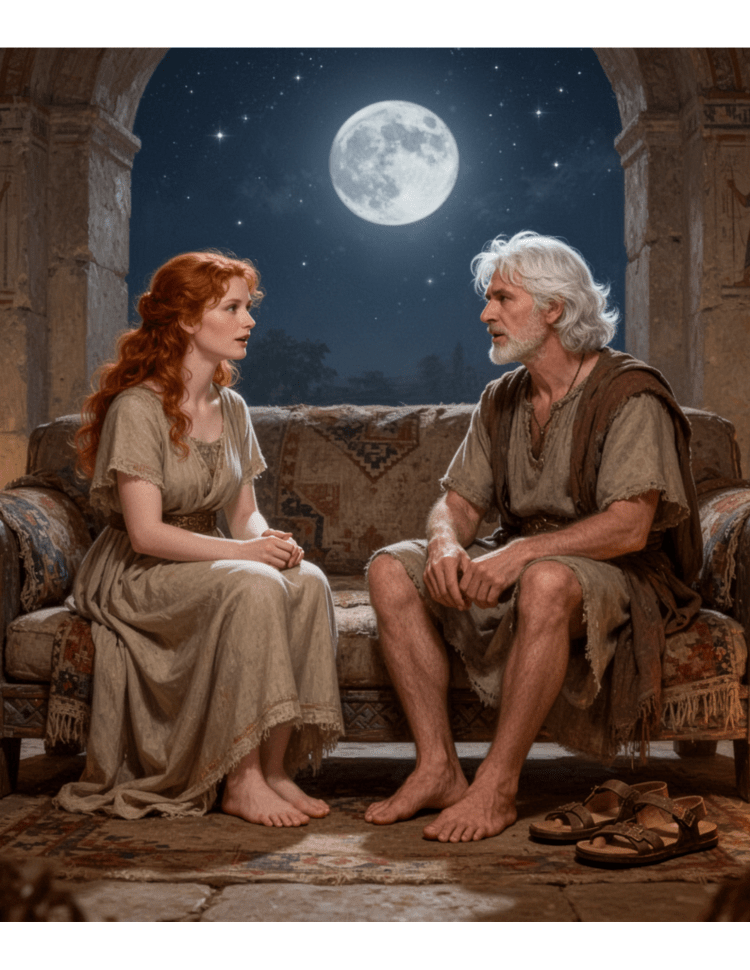
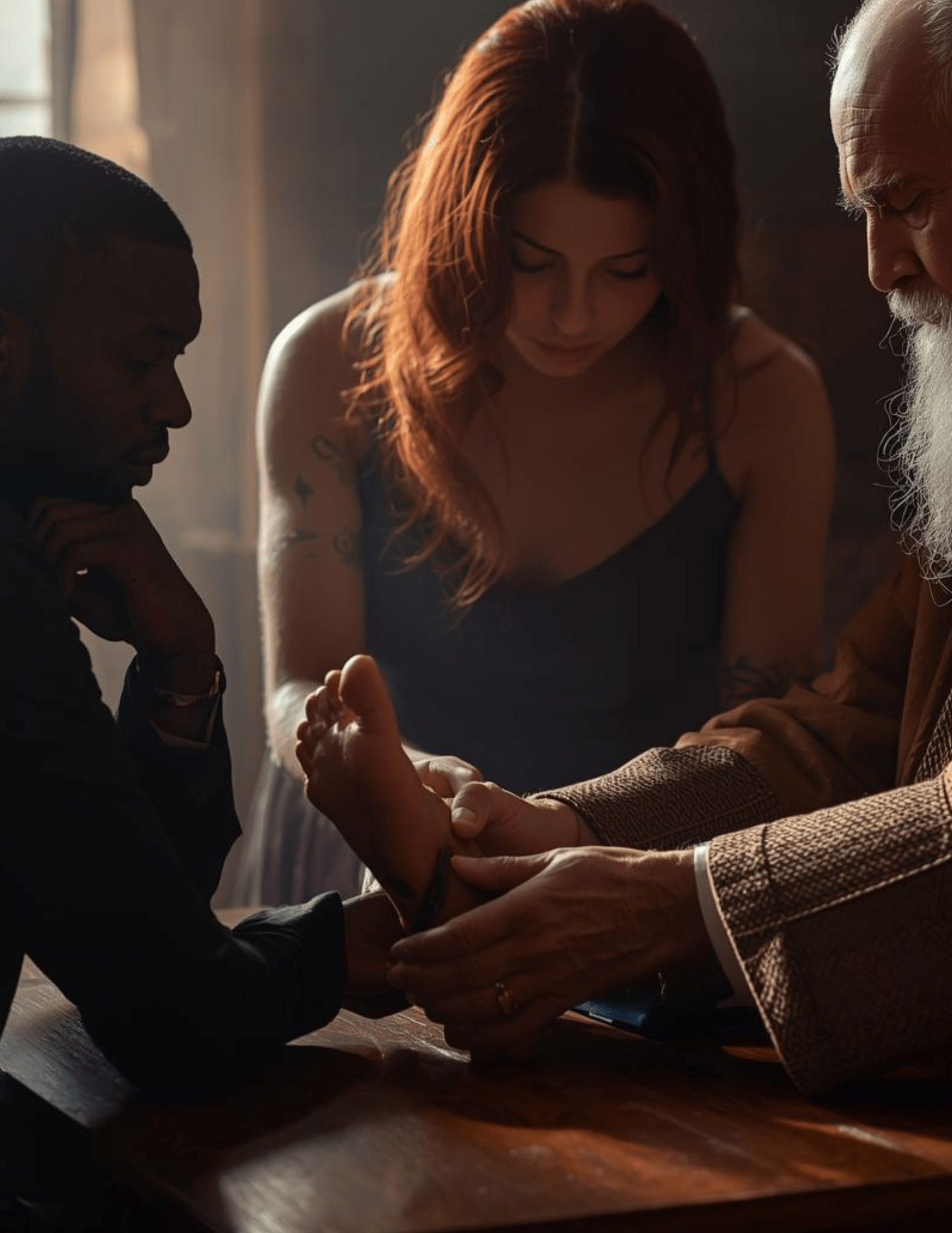
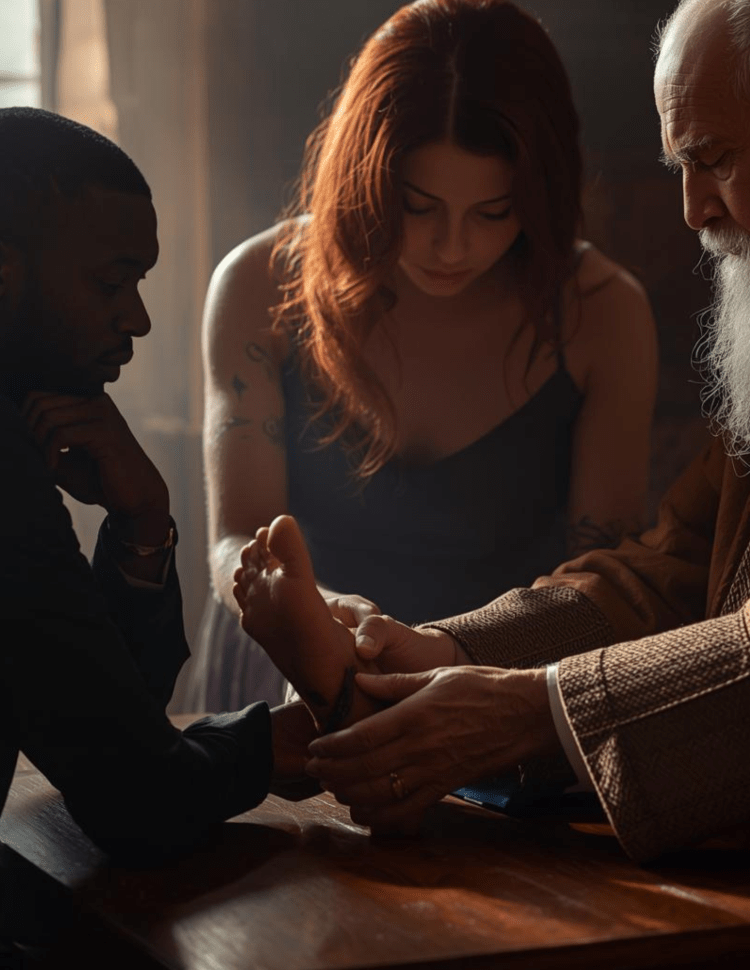
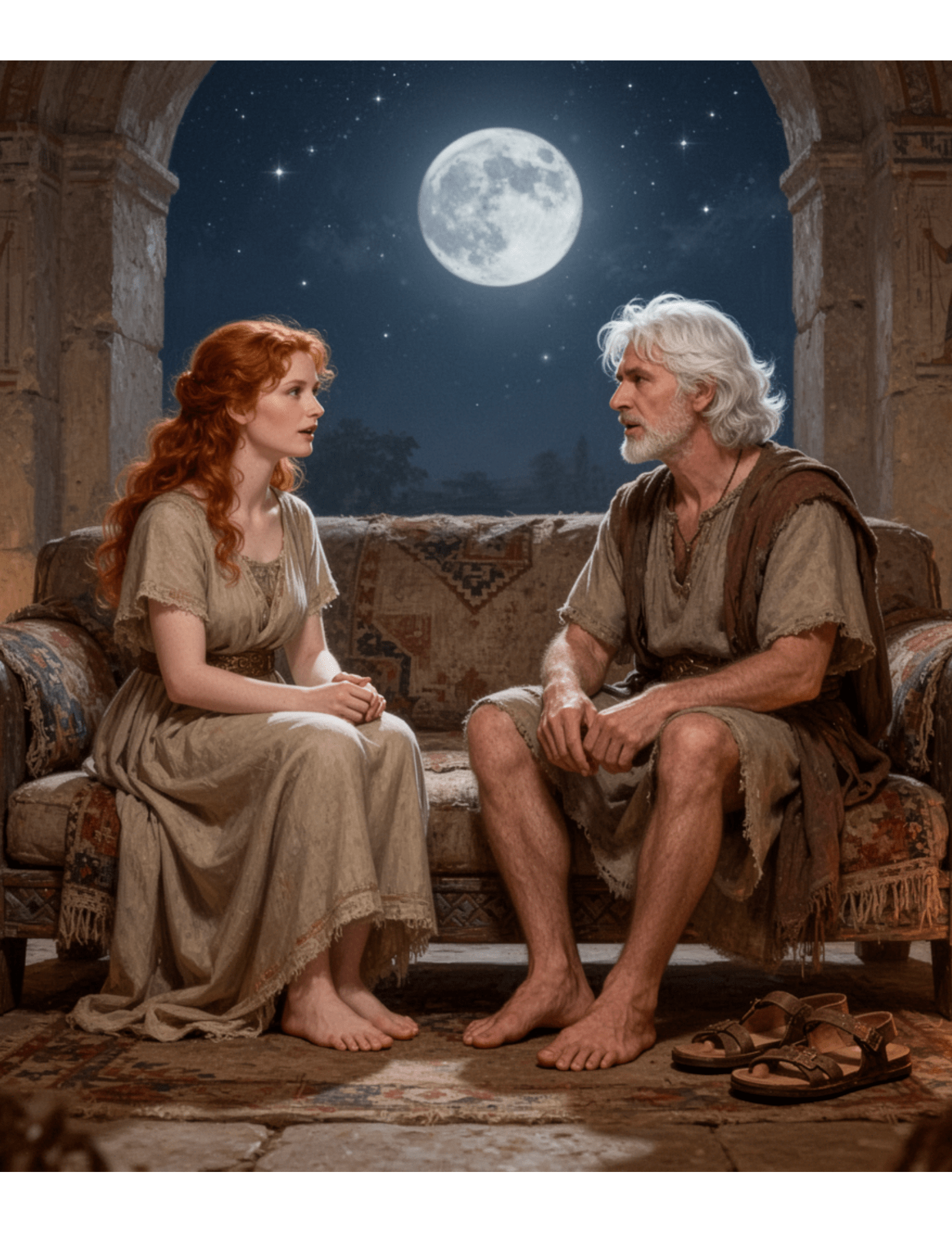
Man and woman in a first-century setting seated face to face on a couch with sandals removed, moon and night sky visible through a parted curtain behind them.
“How can a man be born when he is old?” Nicodemus asked. “Can he enter his mother’s womb a second time to be born?”

Jesus is always referred to as He. Does the “He” stand for he and she — two people speaking face to face? Many people unfamiliar with the fact that Pharisees such as the Teacher of Israel called Nicodemus (whose name means “victory of the people”) would have believed in the possibility of being born again.

The Sadducees would not have, and the Samaritans were marginalized and excluded by both groups. Thus they were “kept in the dark” by Jewish authorities and by society. The Samaritans did, however, have knowledge of the first five books of the Bible.

No doubt a Samaritan woman would have known that the Teacher of Israel — whom the Egyptians called Moses — was named because he was found in a small basket of straw, set among reeds, and canes in the waters of great river delta. There his saviour was a woman of a royal household who adopted him as her own dear son.

A Samaritan woman would also have thought of the Teacher of Israel as one who brought victory to the people — Hebrews and Gentiles alike, even those thought of as rabble —by freeing them from Egyptian slavery.

So what has the birth of Moses, the Teacher of Israel, got to do with the story of Jesus and the Teacher of Israel meeting under the cover of darkness?

This under cover story comes in the third chapter of John’s Gospel and follows the Cana Third-Day event. In Hebrew, Cana means the place of reeds. At Cana the bridegroom — the master of the banquet in Mediterranean custom — is called aside. Believing the servants responsible for the best wine he has tasted, he praises them. Yet he does not yet know the Mother of Jesus was the wine’s source. The servants know. Those who were present may know. But many who hear the story later remain in the dark.

In Cana, six stone jars had been set aside for the Jewish rites of purification.

Each jar contained about thirty gallons — roughly one hundred and twenty quarts. According to Deuteronomy 34:7, Moses lived to be one hundred and twenty years old. That fact may have nothing to do with the six stone jars set aside. Yet after the bridegroom is called aside and the wine declared the best, Jesus cleanses the temple of merchants and money-changers — likely Sadducees.

With this cleansing of the temple, it is noted that this house is the house of Jesus’ Father and had been under construction for forty-six years. Readers through the centuries have wondered why the age of the temple is mentioned.

Those paying attention during Lent when the Bridegroom is called aside, or taken away will see this time as a time of preparation, when the Bride fasts, repents, and prepares herself for her Bridegroom. They would understand this reference to the destruction of the temple as Christ’s body, and how this body so destroyed would be cleansed and would be raised again on the Third Day.

And those well acquainted with Psalm 40:6 will hear:

Sacrifice and offering You do not desire, but my ears You have opened. Burnt offerings and sin offerings You do not require. “

Followed by the seventh verse:

Here I am, it is written about me in the Scroll — the Megillah.

The Megillah par excellence is the Book of Esther, where a woman saves her people.

A Samaritan or a Gentile might not have known the Psalms well. Thus is it any wonder then, that those excluded from the Father of Jesus’ house — but hearing words such as these — in the Court of the Gentiles are pressing in to see a long-awaited messianic figure that has been called.

Yet Moses, the Teacher of Israel, upon descending from Mount Sinai with the Ten Commandments had been instructed to keep those who had not been consecrated — called aside — from seeing the Lord. With the coming of the Forerunner called John the Baptist, many of his followers would have been those in the dark, considered unclean.

In the darkness, those pressing in may suppose whose voice is speaking. For they would not have been among the consecrated. Thus the voice they hear may not belong to the one they suppose. For as the voices unfold in darkness, it becomes difficult to know where one speaker ends and another begins.

For the ancient text contained no quotation marks or versification — only words carried across the dark moonlit night — perhaps by merchants exploiting the songs of bards or romantic poetry of women. For as two teachers talk, the Teacher of Israel and the one identified in this text as Jesus speak— one Teacher says, and the other answers.

Truly, truly, I tell you, no one can see the kingdom of God unless he is born again.
How can a man be born when he is old?

And Nicodemus asked:
Can he enter his mother’s womb a second time?

Jesus answered.
Truly, truly, I tell you, no one can enter the Kingdom of God unless he is born of water and the Spirit…

Do not be amazed that I said, You must be born again.

As a mother gives birth her water breaks, so too the Spirit gives birth as her water pours forth like an everlasting Spring — in the fullness of time — at Noon — when the people of God (female and male) excluded from the inner courts of the temple could claim their inheritance as sons of Abraham.

As in the dark of a mother’s womb, the child to be listens for the Mother’s heartbeat and feels and responds with the rhythm of her breath.

The wind blows where it wishes. You hear its sound, but you do not know where it comes from or where it is going. So it is with everyone born of the Spirit.

“How can this be?
Nicodemus asked.

You are Israel’s teacher.
Said Jesus.

And you do not understand these things. Truly, truly, I tell you, we speak of what we know, and we testify to what we have seen, and yet you people do not accept our testimony. If I have told you about earthly things and you do not believe, how will you believe if I tell you about heavenly things? No one has ascended into heaven except the One who descended from heaven — the Son of Man.

This Son of Man reference, would be like bait to a fish. The Teacher of Israel is a Pharisee and would surely know who the Son of Man refers and what the Prophet Daniel said concerning the Son of Man.

But would a Samaritan Teacher know? Would a Sadducee?

A Sadducee would recognize the reference, but they took the Bible literally and didn’t believe in heavenly things. And in Daniel 7:13 the Son of Man is described as someone like the Son of Man, arriving with clouds of heaven to judge the world.

Thus, who are “the we” in the above conversation who testify to what we have seen — who believe that the Son of Man ascended into heaven and spoke with God “face to face” and then descended?

Israel’s Teacher would surely know.

If the “we” is the Teacher of Israel and his disciples, it is possible that Jesus leaps in, saying:

Just as Moses lifted up the snake in the wilderness, so the Son of Man must be lifted up, that everyone who believes in Him may have eternal life.

A Sadducee would likely call this blasphemy or at least think the idea of Moses coming back to life and ascending on the Third Day as he did in Exodus and then returning with the Ten Commandments, absolute nonsense. And if so why would the Teacher of Israel called Moses by the Egyptians, be talking with a teacher in the dark saying:

Rabbi, we all know that God has sent you to teach us. Your miraculous signs are evidence that God is with you….
How can a man be born when he is old?
Can he enter his mother’s womb a second time to be born?

____________________________________________________

This is the tenth in a series of Epiphany reflections paving the way for the Cross. Now in Lent, the next Lenten Epiphany turns to the Testimony of Israel’s Teacher identified as the Forerunner and to another Jesus Talk — at the Samaritan Well — at NOON.

If you would like to receive the next reflection, be sure subscribe.
Epiphany IX: The Bridegroom Called Aside — Set Apart

On the third day a wedding took place at Cana in Galilee. Jesus’ mother was there, and Jesus and His disciples had also been invited to the wedding. When the wine ran out, Jesus’ mother said to Him, “They have no more wine.”

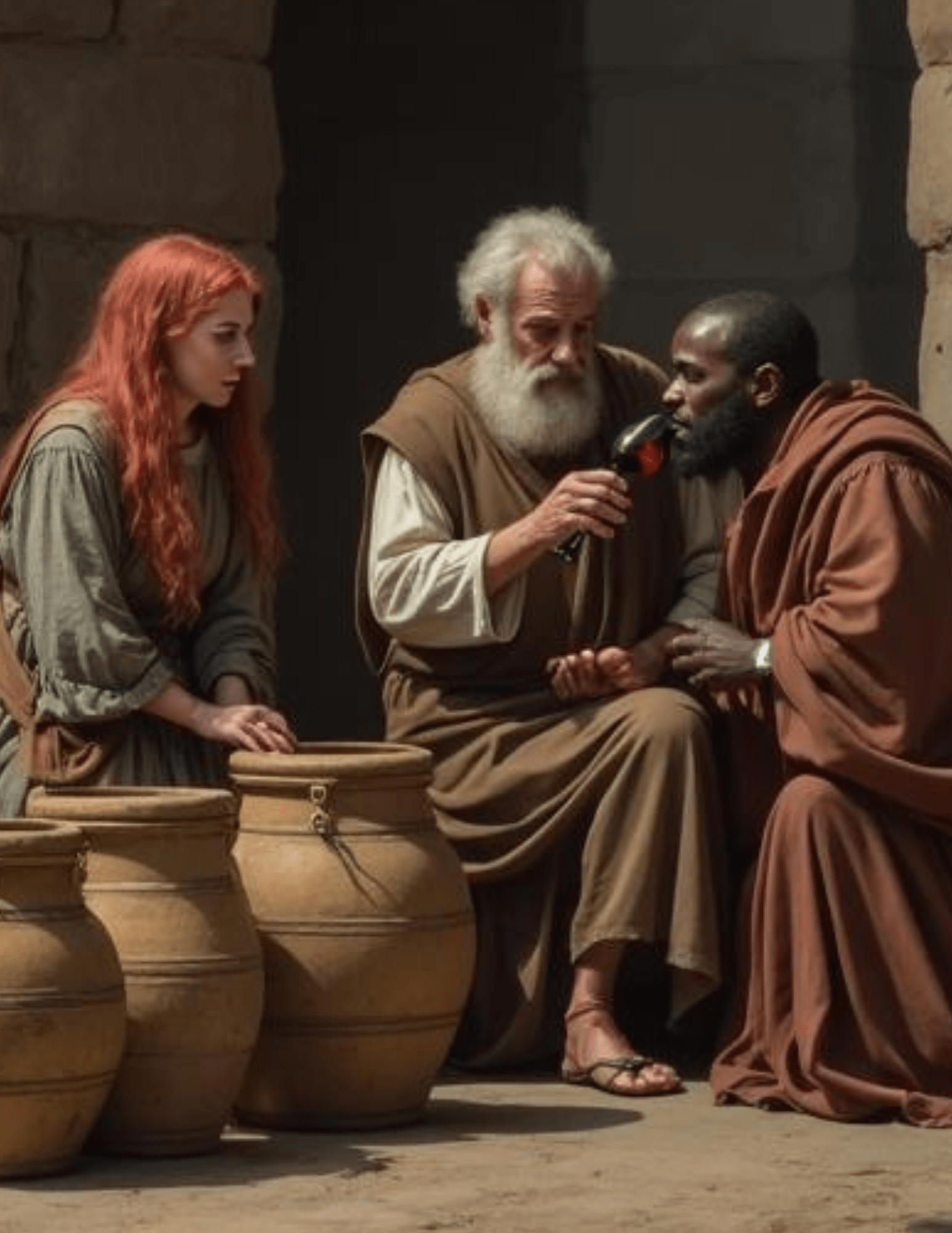
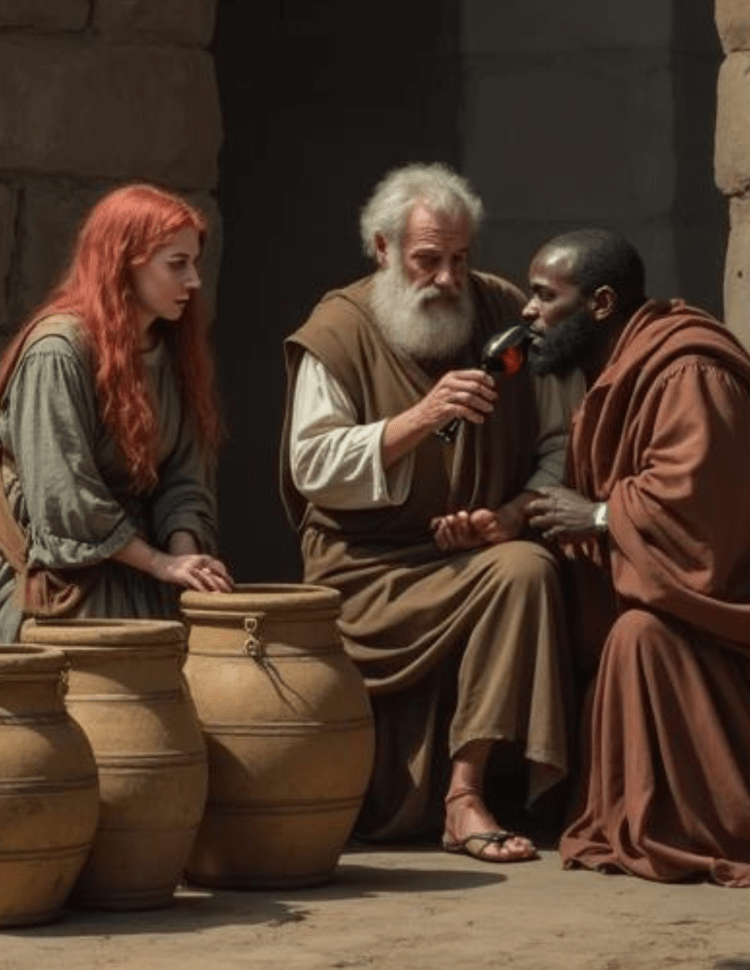
A red-haired woman rests her hand on a stone jar as an elder, professorial-looking man lifts a glass of wine for a black man draped in saffron to taste.
Is the Master called the Bridegroom Aside?

Woman, what is that to you and Me?” Jesus replied. “My hour has not yet come.

His Mother said to the servant, “Do whatever he tells you.”

Now six stone water jars had been set there for the Jewish rites of purification. Each could hold from twenty to thirty gallons. Jesus told the servants, “Fill the jars with water.”

So they filled them to the brim.

“Now draw some out,” He said, “and take it to the master of the banquet.”

They did so, and the master of the banquet tasted the water that had been turned into wine. He did not know where it was from, but the servants who had drawn the water knew. Then he —called the bridegroom aside — and said. “Everyone serves the fine wine first, and then the cheap wine after the quests are drunk. But you have saved the fine wine until now!”

Jesus performed this, the first of His signs, at Cana in Galilee. He thus revealed His glory, and His disciples believed in Him.

_____________________________________________

Notice the phrase “called the bridegroom aside.” In the language of Scripture, to be called aside is to be set apart — consecrated. In Middle Eastern culture the Bridegroom is also the Master of the Banquet, the one responsible for the feast. And so here too the one tasting the wine is both the Master of the Banquet and the Bridegroom — the one set apart and taken away or aside in Lent, because he does not yet know the source of the wine. For his Bride is the one who told the servants, “Do whatever my son tells you.”

At the end of this well known story, Jesus’ glory is revealed, and John proclaims that this was the first of His signs at Cana in Galilee. But this raises a deeper question: Who is Jesus? If Jesus is the Bridegroom who judges the wine to be the best wine, how is His Glory revealed?

In Acts 3, Simon Peter and John stand together before the Gate called Beautiful, and Simon says: “Pay Attention.” In John 3 and in Exodus 3, the Teacher of Israel — called Moses in Exodus and Nicodemus in John — speaks with the I AM.

Yet in John’s Gospel, the Teacher of Israel also appears as John the Baptist, the Forerunner.

In Exodus the Unburnt Bush stands as an Icon of the Mother of God’s pure nature as the source — the I Am who is and who will be.

As the fire is seen by the Teacher of Israel, this bush, this little tree is not consumed. The fire within her is not overwhelmed, and this voice speaking with such power is firmly planted upon a magnificent rock called a mount.

In wedding terms, a marriage is consummated when the Bride and Bridegroom share their passion, their fire for each other as man and wife. The Bible calls this a sacred mystery. For when a man leaves his father and mother and is united with his wife, the two become one flesh.

On the Third Day in Exodus 19 there is a feast. In Jewish tradition the events of the third day mark the moment when God descends on Mount Sinai to give the Ten Commandments. This event has often been understood as a spiritual wedding, with God as the Groom and Israel as the Bride.

Yet Moses speaks to God and God answers with thunder, as if calling attention to heaven’s first marriage of lightning and thunder — the creative power that spoke Adam and Eve into being. This Third Day therefor becomes a covenanting — a betrothal ceremony that reminds those gathered for the feast of the importance of the sacrament of marriage.

Pay attention. In Exodus there is thunder, fire and smoke. Every school child knows that thunder and lightning belong together: lightning appears in the sky, and thunder answers. The Teacher of Israel, called Moses by the Egyptians, brings his follower out of the camp to meet God at the foot of the Mountain. As the ram’s horn sounds and grows louder, Moses speaks and God answers him in the thunder.

The LORD descends upon the top of Mount Sinai and calls Moses to the summit. Moses ascends, and the Lord tells Moses to warn the people and priests not to push forward to see the Lord, unless they have been consecrated — set apart — made Holy for a divine purpose.

The Cana story is also a betrothal and the first step of the marriage covenant. Here the Bridegroom is called aside to judge the wine the servants have prepared under the direction of the Mother’s son — the Teacher of Israel — later known by the name Jesus, the son of the Father.

Yet at the end of this story John proclaims that this sign at Cana revealed Jesus’ glory, and His disciples believed in Him. Still this is a puzzle, for in Luke’s Gospel the glory of the Lord shines around the shepherds in Bethlehem on the night when Mary gives birth to Christ.

According to the Pauline author man is the glory of God and woman is the glory of man.

This raises another question:

Is the Mother of God the glory of the Father of God, and is the Cana Third Day event a re-covenanting ritual of their betrothal — at the beginning of the world?

Or is this simply some village wedding that Jesus and his Mother were invited to attend?

In the next chapter, Jesus appears under the cover of darkness with the Teacher of Israel, and people begin to ask the Question:

Who is the Bridegroom?
Is the Teacher of Israel, the Christ?

______________________________________________

This is the ninth in a series of Epiphany reflections paving the way for the Cross. Now in Lent, the next Lenten Epiphany turns to the story of Jesus and Nicodemus under the cover of darkness — and the light this brings to their faith journey.

If you would like to receive the next reflection, be sure subscribe.
Epiphany VIII: The Anointing

In Bethany, Simon judges the Teacher — the Prophet of Israel.

Where is Grace while her Lord’s feet are anointed?

Luke presents Simon as the host, yet Simon acts as if he is not the host. He does not wash the feet of the Teacher — the Prophet of Israel. He remains sitting aloof, withholding the respect and honour owed such a distinguished guest.

When the Woman with unbound hair enters — carrying an expensive alabaster jar — Simon thinks to himself:

If this man were truly a prophet, he would acknowledge who is touching him — and how he himself knows of her sin. 

The Teacher observes Simon sitting aside, withholding his welcome. He turns toward Simon, and the two enter into conversation. The Teacher tells a parable — of two debtors, one owning much, the other little — and asks Simon which will love more when the debt is forgiven.

  • Simon answers: the one forgiven more.
  • The Teacher says to him: You have judged correctly.

With these words, the Teacher confirms Simon’s role as Father of the Law and as Nathan, the prophet, a true Israelite beneath the fig tree of memory — who once judged David. For David had abused his power when he took Bathsheba, the wife of another man, and sent her husband into battle where he lost his life.

The parable of the two debtors does not deny what Simon is thinking. It confirms it — for those who are paying attention. Parables reveal and conceal at the same time. Simon, described here as Pharisee, stands as Father of the Law and Oral Tradition. Yet his posture — seated apart, watching the Woman as she bends to anoint the feet of the Teacher of Israel — reveals the jealous tension within him.

The Teacher, knows what Simon is thinking — not by clairvoyance, but because the Woman has anointed his feet as if he were the Son of David and she were the stolen Lamb.

The people gathered for this dinner Luke recounts, know the story of David and Bathsheba. When David, took the poor man’s lamb, the prophet Nathan gave David a parable, as a life lesson and a gift of God.

A red-haired woman pours water into a glass beside a smiling black man with a rooster perched on his shoulder and a hen with three chicks at their feet.
If you knew the Gift of God AND who it is asking you for a drink

Through that parable, David recognized himself as the one who had stolen and abused his power — declaring himself someone who should die. And Simon he recognized himself as someone who had deliberately sinned by withholding his hospitality.

So now, again, the Father of the Law and Oral Tradition, setting himself apart, judges himself and one of David’s lineage as prophesied — through parable. When Simon declares that the one forgiven more will love more, and the Teacher answers, You have judged correctly, Simon stands in the place of the prophet — revealing the sin the Law creates to show the necessity of grace.

For from the beginning, those created in the image and likeness of God became separated from one another, and from God, when they took into themselves the knowledge of good and bad — hiding themselves with fig leaves rather than confessing.

Yet beneath the Law rests the sapphire foundation — the hidden body of grace that once openly dwelt with Adam and Eve, like thunder and lightning permeating and nourishing the whole inhabited world —the living earth and the life-giving sky — before the Fall.

By speaking in parable, the Teacher does not deny what Simon perceives, but holds back its full meaning — saving and preserving what must remain a private affair until the Bridegroom thunders forth his love for the Bride, and the Teacher rises, washed clean, to stand in the place of the Priest, and proclaim — “Kiss the Bride.”

When that moment comes, forgiveness will rise as the Light dawns and rises as surely as sunshine after a storm greets each hour.

_______________________________________________

This is the eighth in a series of Epiphany reflections paving the way for the Cross. Now in Lent, the next Lenten Epiphany turns to Cana — where the Woman says to the Son of the Father, “They have no more wine.” What appears to be lacking becomes a sign for those paying attention — that prepares the way for the Cross.

If you would like to receive the next reflection, be sure to subscribe.

Epiphany VII: The Sapphire Wall

What happens when the early church community tries to build a kingdom without paying close attention to John — honouring him as Forerunner and Teacher of Israel?

Simon Peter judges Ananias and Sapphira for concealing the full price of the field they sold.
Moses — the Teacher of Israel

More importantly, what happens when the newly formed faith community, are unprepared to fully acknowledge the Gate — the Woman Jesus — as the “I Am” who spoke with Moses the Teacher of Israel hundreds of years before?

In Acts 4 the early community looks successful: “abundant Grace was upon them all.” No one lacked, and believers freely laid their possessions at the apostles’ feet. The Church appears unified, generous, and holy.

Yet the next chapter exposes a great divide — a moment when Satan enters the Story again.

Ananias and his housewife, Sapphira, hold back some of the proceeds from the field they sold. Simon Peter confronts Ananias directly:

"How is it that Satan has filled your heart, to lie to the Holy Spirit...? "

To understand why they hold back the truth of their treasure, it is important to turn back — to a pre-Cross moment when judgment, forgiveness, and hidden knowledge collided in Bethany — in the house where Simon hosted a dinner.

But turning back also requires something else: adopting the mind of Christ.

In Scripture, names are never incidental. They carry identity, calling and destiny. God changes names when lives change. God hides meaning in plain sight.

In Hebrew, Ananias echoes the meaning of John in Greek — God is gracious.

And Sapphira recalls sapphire — the stone associated with the glory of God, pavement beneath His throne, the jewel set in the High Priest’s breastpiece.

Yet this veiling and withholding of Glory and her sister Grace compel Simon Peter to judge.

"For it is the glory of God to conceal a matter, to search out a matter is the glory of kings." (Proverbs 25:2)

Turning back, recall that Moses — the Prophet, the Teacher of Israel — unveiled his face when he spoke with God face to face, yet veiled his radiant face when he taught and prepared those who followed him to meet God.

_________________________________________________

This is the seventh in a series of Epiphany reflections paving the way for the Cross. Now, in Lent, a Lenten Epiphany turns back to the pre-Cross event — when Simon judges Jesus the Teacher as the Prophet — and when the Woman Jesus, called a sinner, anoints Jesus the Teacher’s feet.


If you would like to receive the next reflection, be sure to subscribe.

Epiphany VI: The Crux

The Kiss and the Capstone

The healed one in Acts 3 is “over forty years old.” For centuries, this detail has been treated as a biographical footnote. Yet this is a clue that something deeper is at work — the very Crux of the Matter.

A Black man and a red-haired bride kissing face to face in wedding attire.
Sealed with a Kiss

The scandal is not that the Bride finally walks.

The scandal is that she is the very Branch — the Stick — John and the prophets have watched over for centuries.

If Peter’s lifting of the Bride is the cornerstone of the story, then her union with the Bridegroom — sealed with a kiss —becomes the story’s capstone.

Christ is both Bride and Bridegroom.

Their marriage, witnessed by John the Forerunner and all who follow him, locks this seal into place — as a capstone binds and steadies an arched gate. This living, eternal marriage redeems and restores the fourfold harmony of Creation.

What took so long?

A human child forms for 39-40 weeks before birth.
Seem in this light, it is no coincidence that this long-hidden life is already past forty when she takes her fiancé’s hand and rises — leaping as a gazelle — to stand beside Simon Peter and his lead hand, John.

The Golden Lampstand — beaten to resemble the Amygdala — was kept in the Holy of Holies, glory too radiant for the people to bear.

Simon Peter himself, shaped by this concealment, hesitated to recognize that she and he together were the Christ, the living rock — and that when he carried her, the Cross of Jesus, he was carrying her: the Almond Branch of sacred memory — ‘”killed” and “crippled” in public, to be raised and restored to life on the third day.

Thinking as a man — as if he were merely Simon the Magus and not the Rock — Simon Peter supposed, as did John’s followers, that one fit to carry the Cross of Jesus ought to have gold and silver, or be a king like Solomon, or at least be a prophet like Nathan who knew firsthand how she became tarnished with sin.

So Simon Peter denied that this man could be him — a Pharisee, an ordinary faithful Israelite who heeded the word of God, eating, drinking, and singing in fishing villages, on roadsides, and in taverns.

This was not merely disturbing or perplexing. It was preposterous.
God is eternal. Humans are not.

Simon Peter was still buried in human thinking.
He could not imagine possessing eternal life — or bearing the responsibility of an eternal father called to raise a divine human family.

_________________________________________________

Yet in Lystra, lightning strikes — the veil tears — and the one compelled to carry the Cross is suddenly recognized. (Mark 15:21)

The crowd, hearing the Pauline proclamation flash as lightning, identify Barnabas — Joseph of Kyrene—with Zeus, Jupiter, the god of thunder, and the Pauline speaker with Hermes, the lightning-swift divine messenger, Mercury the bright morning star. (Acts 14:12)

So as Jonah long ago did, Simon Peter hesitated to accept such a divine calling. (Matthew 16:21)

Now that Simon Peter has taken her hand and she stands before the people, leaping as a gazelle, the astonishment of both the crowd and the authorities must be calmed — lest a shipwreck lose her anchor and jettison her precious cargo.

And so, with that first public taking of her hand, she is publicly betrothed. The work of preparing the Father’s hands and sharing the Good News begins — for each newborn Christian must learn to walk the talk, first on dry land and then on stormy seas.

__________________________________________________

This is the sixth in a series of Epiphany reflections. Now that Lent has begun, Epiphany VII turns to Simon Peter’s judgement of Ananias and Sapphira — paving the way for the Cross.

If you would like to receive the next reflection, be sure to subscribe.

Epiphany V: Disturbance on Solomon’s Porch

The authorities were disturbed and perplexed.

How could laymen — men without formal authority, men who did not wear the robes of the priestly class — speak with such confidence, such clarity, and such authority?

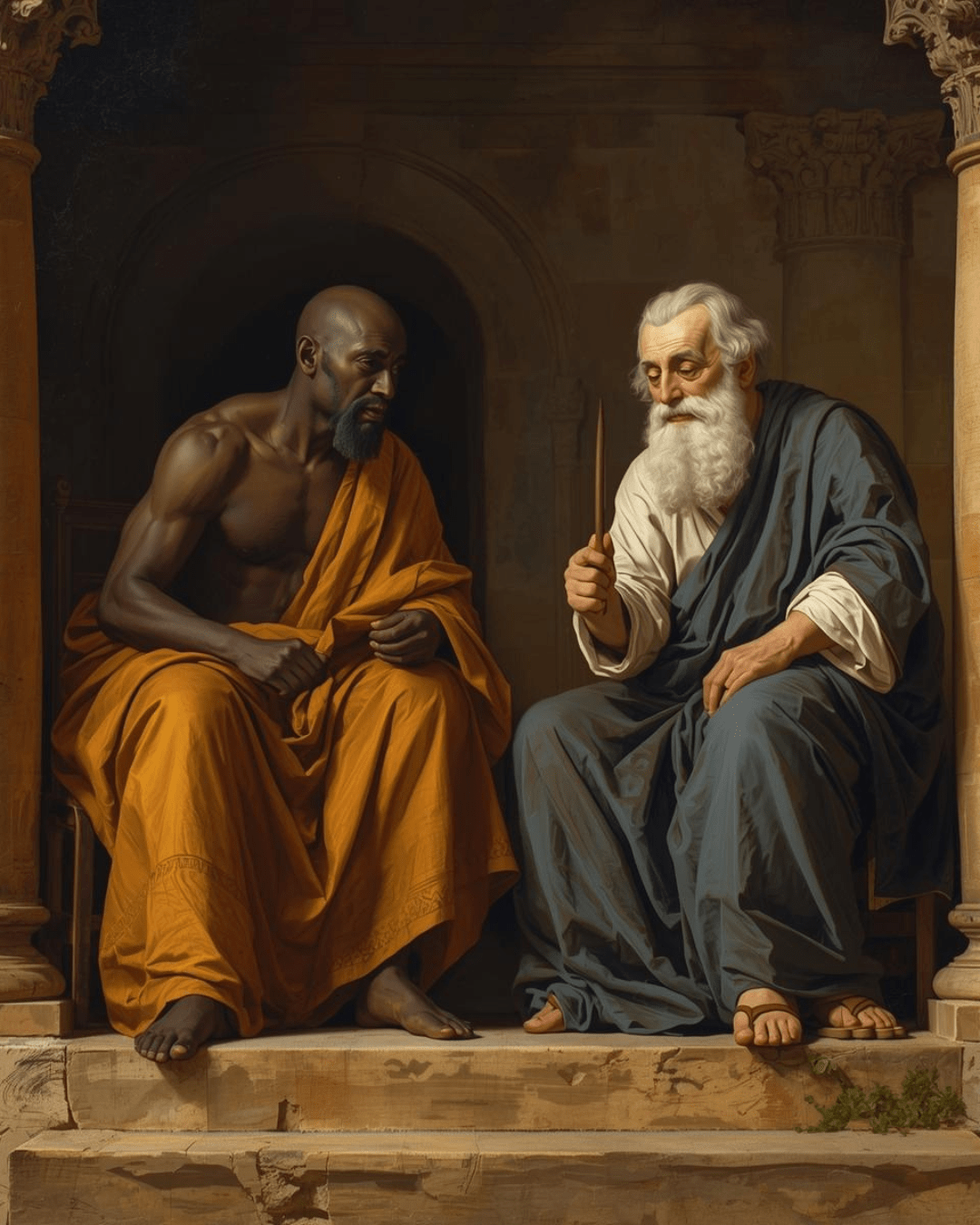
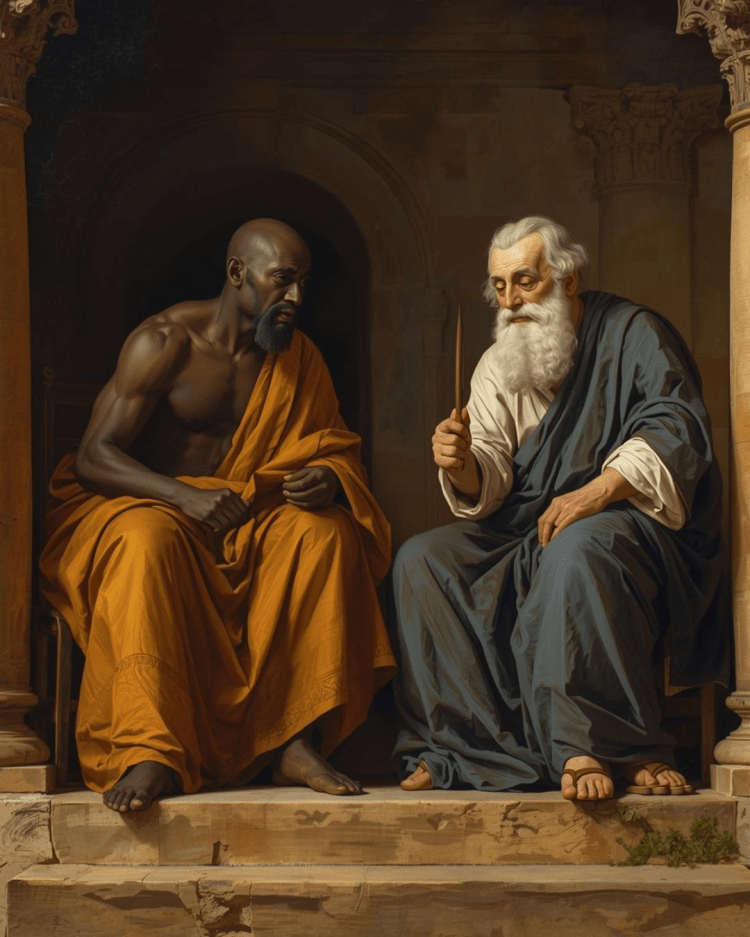
On a stone porch, a Black man in saffron robes sits beside an older white man with a beard, who holds a leafless branch.
Disturbance and Perplexity — Giving way to shared allegiance

In the order of the Temple, Peter and John were supposed to be followers, not teachers, servants, not leaders. Yet the crowd treated them as witnesses to something greater than any institutional power.

What perplexed the ruling class was not simply how the crippled one now walked. It was the claim that this miracle revealed the fulfillment of messianic prophecy — a fulfillment that seemed to inaugurate a new kind of authority, grounded not in rank, or hierarchy, but in a living encounter with Christ: the Bride belonging to the Bridegroom, as testified by John.

In the logic of the authorities, if John had lost his head, had he truly died? How could he now be seated here with Peter — filled with the Holy Spirit, full of ancient memory, wisdom and authority?

Greatly disturbed they had Peter and John taken into custody overnight.

“What shall we do with these men?” they asked. It is clear to everyone living in Jerusalem that a remarkable miracle has occurred through them, and we cannot deny it. But to keep this message from spreading any further among the people, we must warn them not to speak to anyone in this name.” (Acts 4: 16-17)

Yet the message spread anyway. This was no mere act of charity — five thousand people were fired up even as the authorities tried to silence it. Was this merely the rumour of the grapevine, or a faithful allegiance to the authorship of the Holy Spirit?

And so the authorities and those in their allegiance remained perplexed:

“…They could not find a way to punish them, because all the people were glorifying God for what had happened. For the man who was miraculously healed was over forty years old.” (Acts 4: 21:22)

Truly this was — and is — the Crux of the Matter.

How could this Healed Crippled One, be the crucified one? Was not Jesus the Crucified One, under forty years old pinned to the Cross — to the Amygdala the prophets declared the Lord was watching over? (Jeremiah 1:11-12)

______________________________________________________________

This is the fifth in a series of Epiphany reflections. Epiphany VI, turns to the Crux of the Matter: how the forty-year-old Crippled One is brought into public view as the Crucified Bride — when Peter takes her hand —a truth the authorities want to keep sacred.

If you would like to receive the next reflection, be sure to subscribe here.

Epiphany IV: Peter’s Speech

The crowd gathers at Solomon’s porch as February’s winter light lingers on the stone — like a rose blooming out of season, clinging still to the hope of spring, presenting what has waited through eons to bloom more beautiful.

A single red rose blooming in deep snow.
Encountering Ancient Love at Solomon’s Colonnade

As the crowd swells around this unexpected bloom — the restoration of a crippled one — Peter steps forward to make one thing clear: this Crippled One did not walk and flower from his power or John’s alone. Rather, the moment cannot be understood apart from an ancient love that had been alive for centuries — wounded by dishonesty and disbelief, but never extinguished.

Those who have long awaited this moment are ready for Peter’s words. They hear him echo John the Forerunner — calling them to repent and remember — so that their transgressions may be forgiven, and the Crippled One — appearing like a rose in winter — may be restored as the very foundation stone.

First came the Johannine Teacher — like a father of Eros — speaking to her under the cover of darkness, awakening the Love she had carried in her soul since the songs of Solomon and long before — as the Gardener of the fig tree.

Then in the same town of Andrew and Peter, when Phillip found Nathanael — a true Israelite — her thorned branches began to bud and bloom like a flower in winter, watching, and waiting for the Gift of God who would one day take her hand and redeem her in public.

As you listen to Peter’s speech, notice that Scripture speaks in male grammar, yet the mystery revealed is not only masculine. When Peter says “He,” listen for what has long been assumed, and also listen for the whole Christ — Bride and Bridegroom together — standing fully alive at the heart of this moment, as testified and witnessed by the Johannine Forerunner.

“Why do you stare at us, as though by our power we had made this person walk? The God of Abraham, Isaac, and Jacob…has glorified his servant Jesus…” (Acts 3:12-13)

“Repent therefore, and turn back, so that your sins may be wiped out, so that times of refreshing may come from the presence of the Lord…” (Acts 3:19-20)

“…whom heaven must receive until the time for restoring all things, as God spoke long ago through the prophets.” (Acts 3:21)

Heaven cannot be understood simply as a spiritual, bodiless realm. It is better seen as a treasury of holy memory where God’s ancient love is preserved — publicly in Scripture, in prayer, and in the hearts of believers — until the living Christ: the Bride and Bridegroom together is recognized face to face in the fullness of time, as the Johannine Forerunner testified.

_____________________________________________

This is the fourth in a series of Epiphany reflections. Epiphany V, turns to what the authorities make of this amazing moment.

If you would like to receive the next reflection, be sure to subscribe.

Epiphany III: At Solomon’s Porch

At Solomon’s Porch, Peter takes the hand of a person described as crippled from birth — one who cannot yet walk the talk. As with any newborn, the lack is not desire but power: power in the limbs, power to communicate. Newly born into life, such a one appears as a beggar.

Shaded stone porch with columns forming a public walkway.
Why the Porch?

A woman pledged in marriage yet not taken, not yet redeemed, bears the promise of life, yet cannot bring forth the family she hopes for without a willing bridegroom to take her hand in a public way.

For centuries, readers have assumed this cripple was male and dependent on charity — mistaking expectancy for a plea for money. Yet those watching, alert to John’s testimony, see Peter draw attention to himself and to John, and they are rewarded. In this act the promise takes place: the Bride belonging to the Bridegroom steps into public life, as Peter takes her and and she clings to him — and to John — just as John the Forerunner had testified. (John 3:28-29; John 20:17

It is in this same light that the Teacher’s words to Mary after the resurrection must be heard. “Do not cling to me” does not deny that she is the Bride of the promise: it clarifies that the Teacher is not the Bridegroom she and many others had supposed. In that moment, words spoken long before — “cling to the Lord” and “If you knew the gift of God” — dry her tears and remove the scales of a shared dishonesty that had blinded her eyes. (Proverbs 16:11) Thus her feet are quickened, so she can honestly go and live the promise. (John 20:17; John 4:10; John 1:47)

The female gender of this crippled man, this person, matters. Women have been historically crippled by male grammar and by the way the Cross has been publicly interpreted — narrowing who Jesus Christ of Nazareth is perceived to be.

Yet the prophet Isaiah spoke of a Branch, the coming Messiah, who would save and preserve a remnant from the house of Israel. The Hebrew word netzer means branch or shoot, and it echoes the name Nazareth — and in the title Nazarene. Scripture pins Jesus to the branch of a tree. And the prophet Jeremiah sees this branch as an amygdala, affirmed by the Lord’s own words: “I am watching over my word to accomplish it.” (Jeremiah 1:12)

So pinned to the Branch, the Amygdala, was seen by many as a scandal, a public offence. Yet Mary stood by the Cross, and other women have stood by her, waiting upon the Word of the Lord to be fulfilled. (John 19:25)

And so the amazed followed Peter and John — and the one clinging to Peter’s hand — into Solomon’s Colonnade, to hear Peter speak on the porch.

Blessed are those who fear the Lord and walk in his ways. You will eat the fruit of your labour; blessing and prosperity will be yours. Your wife will be like a fruitful vine in your house, your sons like olive shoots around your table. (Psalm 128:1-3)

This is the third of a series of Epiphany blog posts. Epiphany IV follows the crowd as they listen to Peter speak.

________________________________________________________

If you would like to receive the next reflection, be sure to subscribe.


Epiphany II: Jesus the Gate

The last blog post, ended with light that blinds and cripples. Scripture does not shy away from this kind of confusion.

Illustration of an open garden gate framed by blooming almond branches, leading into a sunlit garden with trees and flowers beyond.
Jesus the Gate: Beauty Recognized

In the Pauline Author’s first letter to the Churches in Corinth, people were confused. Some were aligning themselves with Cephas, some with Apollos, others with Paul, and others still with Christ. Some may even have supposed that John the Baptist was the Christ — and that Paul, therefore was someone who also baptized (1Corinthians 1:11-13). 

When Simon — called Cephas by some and Peter by others — stood with John in front of the Gate called Beautiful, they encountered a man who had been crippled from birth (Acts 3:1-6). 

The season of Epiphany opens with the Baptism of Jesus in the Jordan by John, following the Holy Family’s journey to Egypt. Tradition remembers this journey led them to Alexander’s place or city—a formative setting shaped by dialogue, debate, and the practices of rhetoric and allegory within Greek and Roman culture

Might a place remembered as the nativity of Apollos be such a place—where Mary and Joseph’s marriage blossomed, and where a magnificent Light, born of their love and witness, began to testify to an eternal love for God and neighbour?

A man crippled from birth sits outside the Gate. The Pauline and Apolline witness to Jesus Christ — the Light born of Mary and Joseph’s marriage — has come into view, but its meaning has not yet taken root. Like all of us at birth, babies do not yet know how to walk and may reach out to shiny things to help them stand. So too, a young disciple of Jesus may see charity in the form of gold and silver — as if the keys to the kingdom Peter holds were made of gold and silver.

But parents and extended family members know when to let a child reach for shiny things — and when to draw them gently out of the way. What first steadies our crippled infant bodies cannot teach us how to walk. Standing is learned by watching, listening, and trusting the voices of those who have already learned to stand.

Illustration of an open garden gate framed by blooming almond branches, leading into a sunlit garden with trees and flowers beyond.

Peter gives what he has — in the name of Jesus Christ of Nazareth

  • Taking him by the right hand, Peter helped him up, and at once the man’s feet and ankles were made strong. He sprang to his feet and began to walk. Then he went with them into the temple courts, walking and leaping and praising God.…
  • When all the people saw him walking and praising God,  they recognized him as the man who used to sit begging at the Beautiful Gate of the temple, and they were filled with wonder and amazement at what had happened to him. 
  • While the man clung to Peter and John, all the people were astonished and ran to them in the walkway called Solomon’s Colonnade.…(Acts 3:7-11).

Something remarkable has happened — not only that one once unable to walk now walks, but that there is no turning back or away. Newly strengthened, she remains clinging to Peter and John as they move together through a place thick with memory, a colonnade bearing Solomon’s name. The crowd follows, astonished. What began at the Beautiful Gate now draws many inward, as if the giving of the hand and the Name has opened more than legs — it has opened a way.

For as Jesus declares in John’s Gospel:

  • “I am the Gate. Whoever enters through me will be saved.”

This is the second in a series of Epiphany reflections. In Epiphany III we follow the movement inward — from the healing of one crippled from birth to the significance of the place where the crowd gathers in wonder: Solomon’s Colonnade.

Epiphany I: Why Egypt? Where Christmas Meets Story

The journey to Egypt made by Mary and Joseph is often imagined as a flight into obscurity, a way of avoiding notice. But the story itself suggests something different. They do not flee to Egypt to disappear. They flee there to be received —to be loved, seen and heard.

Egypt: Alexander’s City — a place where the dawn meets the sun

In Bethlehem, Mary and Joseph are received and given accommodation in a cave — a place some describe as a barn, ill equipped to provide true hospitality. Here, as visitors from the East arrive in the first light of dawn, following a star, they bestow gifts to celebrate the birth of a Holy Man, a Holy Family, as foretold in the Law, the Prophets and the Psalms.

Yet news of this Holy Family — birthed into the world as God’s only begotten — disturbs the status quo. Scripture tells us that when word of a Holy Man, vulnerable as a newborn child, reaches Herod’s ears, he orders — or legally permits, through laws already in place — the killing of all newborns under the age of two. This killing of the innocents was likely carried out by exposure, a common fate experienced by unwanted babies in many cultures at that time, and since.

In Jewish culture, the family — rather than the individual — is the smallest human nucleus. The family therefore begins on the day of the wedding, witnessed and conducted by the rabbi. (see Marc-Alain Ouaknin, Symbols of Judaism, Assouline Publishing, New York, 2000).

In Egypt, the Holy Son goes swiftly into the East — into a world where story, song, and memory are already ancient, where faith is carried not only in texts, but in music, movement, and shared imagination.

So why Alexandria? Why would the Holy Family hurry toward a city — or a place named for a Greek called Alexandros, and not some other place in Egypt?

Perhaps here, what was new would have been recognized as old. A newborn love, coming alive according to prophecy, would have been embraced as an ancient man-child — welcomed, encouraged, and drawn into conversation. This love would have been lifted up by elders who knew how to carry truth in story, and by age-old friends who understood how love grows strong through walking, talking, and shared life.

In this way shared life, an ancient love coming alive would have become a mirror, as if catching the light of the sun to illuminate what had long been planted in the human heart. As this love was shared, it would dwell among a community capable of providing the hospitality such ancient love needed.

Scripture provides glimpses of truth that support the notion that the Holy Family, after the wedding in Joseph’s hometown, went to Alexander’s city — place. Granted, Alexander’s place may not have been the famous city on the Delta. What matters here is not geography alone, but what such a place represents for the faith journey.

The story told in Acts 18 names Alexander’s place as the place of the nativity of Apollos. Granted, the name Apollos recorded in Acts and in the Pauline Letters may not originally have included the final “s.” Nevertheless, the name Apollos — as recorded in Acts 18:28 — means “of Apollo.”

According to widely available historical accounts, political propaganda placed the head of Alexander on one side of a copper coin, with the head of Apollo on the other. In this way, Alexander’s victories were rendered sacred—for he was deified as Apollo, the one who brought Nikē to the dēmos, to the people. This imagery circulated prior to Rome’s rise to power, serving to keep peace when necessary through military strength amid competing Greek, Roman and Arab states.

For those well acquainted with the Gospel story that places the Baptist’s head on a copper plate, it becomes possible to see why early Christians might have linked John the Baptist with Apollos.

This linking of Apollos as a native of Alexandros’ place or city may also have sparked the Pauline question and answer: What then is Apollos? What then is Paul? but servants. (1 Corinthians 3:5).

Further to the scriptural claim that Alexander’s place was the nativity, the birth place of Apollos is the description of Apollos as a learned man who knew only that of John the Baptist. Curious to this little seed of information is the fact that the Pauline author’s question and answer — What is Apollos? What is Paul? but a servant — is joined to the claim that Apollos waters the seeds of the Gospel planted by said author.

Now many will protest, saying but the Pauline author never met Mary or Joseph, let alone the child brought to Bethlehem, the place of Christ’s Nativity, begotten from Mary’s womb.

Yet, Alexandros’ place — whether the famous city of Alexandria or another place bearing Alexandros’ name where the Dawn meets the Sun — the fact remains: the fruit of Mary’s womb, the seed of her womb, needed a place where what was planted in the dawn could thrive in sunlight.

Two further details need to be added so that the watered seeds of Apolline and Pauline cultivation are seen to germinate with God the Father —who supplies the increase. Additional servants are necessary, one being Joseph who accompanied the Pauline author to the Greek and Roman cities of Lystra and Derbe. For Joseph’s name means “he will add” or “the one who brings the increase.”

The second detail adds further light brought in by the Lukan author of Acts who testifies that the Pauline author bore witness to the Jews that Jesus was Christ (Acts 18:5). The same account adds that Apollos vigorously refuted the Jews in public debate, proving from the Scriptures that Jesus was the Christ (Acts 18:28).

The Greek Interlinear text adds still more light here. It presents the Pauline author as bearing witness —to the Jews “to be” the Christ Jesus—who the prophet Isaiah identifies as the suffering servant (52:13 —53:12).

While the Pauline author is doing this, in the same chapter of Acts, Apollos is also proving “to be” the Christ Jesus — in keeping with Hebrews 6:19-20 which identifies the Forerunner as Jesus.

Too much light can be blinding and crippling, especially for those who have been born and kept in the dark.

This is the first in a series of Epiphany reflections. In the next post, I turn to the healing of the man crippled from birth.

If you would like to receive the next blog post, you are welcome to subscribe here.