In the aftermath of World War II, Crete was full of hatred and anger. The country had been invaded by the Nazis and the Cretans vowed they would never stop hating the Germans.
In The Ecumenical Affair a young Canadian woman and an older Greek man find themselves alone one hot July night.
“Tell me a story. About you. When you were a little boy.”
He worms out of his jacket. Fishes into his shirt pocket for a cigarette. Cocks his left brow. She offers no resistance. He lights it. Grips it like before. Leans back. Puts his left foot up on his knee. Blows smoke away from her—pushing out his bottom lip. Continues: “When I was the age of the children in those pictures on the piano the Nazis occupied my country. This you know?”
She shakes her head.
“When the parachutes came, villagers armed themselves with kitchen knives and garden scythes and hid in the long grass at the edge of the field. As the paratroopers landed, the villagers attacked as many as they could. The German high command was of course outraged. In retaliation, they ordered the mass slaughter of whole villages: women, old people, children, babies. You’ve seen how they do this in movies?”
She nods.
“Our village wasn’t directly involved with the invasion. But to make sure we wouldn’t fight back, the Germans took the men away in buses—to camps surrounded by high, chain-linked fences and barbed wire—it was bad for the women. They had no one. No one to protect them from the soldiers.”
“Was it bad for you?’
“I survived. I worked in the Resistance. I could talk to the guards. I could speak German. So, I would tell them stories and sneak in Greek words and things; things that those standing nearby could pick up.”…
The Young Woman. Now middle-aged…sits on a gold and green brocade sofa. On her lap is a best-seller she found at the church bookstore. …
She folds back the cover. Fans the pages. Stops. Creases it open–quarter way from the end.
“Are there any questions? This question was asked by a Greek teacher, a philosopher and a legendary peacemaker…after a two-week Socratic symposium on Greek culture.
As participants rose to leave, Fulghum countered. “What is the meaning of life?”
Hungry to know more, the Woman turns the pages, adding bits from what she already knows:
The legendary philosopher is the general director of an academy dedicated to peace and reconciliation between Germans and Cretans who vowed they would never stop hating each other. The surrounding villagers are fishers, olive oil producers and yogurt makers. This village has a grave yard on top of a hill adjacent to the Academy. In these graves lay the bones of priests, nuns, farmers and fishers who dared to stop the invading Germans. The invaders were armed only with their side arms. The machine guns, ammunition and other weapons were air dropped in canisters. The invading soldiers were horrified to see nuns and priests, old people, and little children killing their comrades. Oh the opposite shore–in Maleme–is the graveyard of the slain Germans.
The Woman places the book on the cushion beside her.
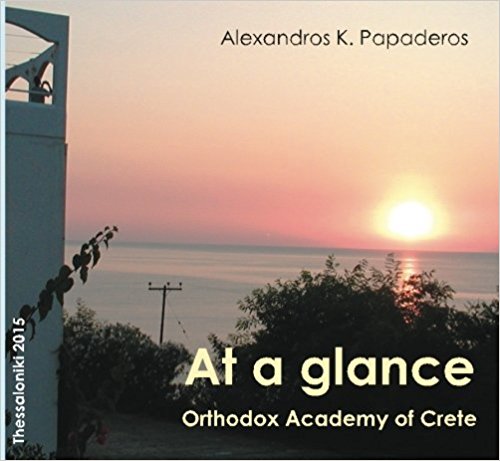
The other day I found a book at Amazon.com called At a Glance written by Dr. Alexandros K. Papaderos, the general director of the Academy the Woman in The Ecumenical Affair reads about.
Papaderos is a man of peace. He co-founded the Academy on land donated by the Greek Orthodox Church. Papaderos chose this site because of its strategic and symbolic “barren” location. On the hill above the Academy is the mass grave of Cretan villagers who dared to stop the invading Germans. On the other side of the bay, on an opposing hillside, are the well marked graves of slain Nazis soldiers.
These two burial epitaphs facing one another serve to remind both sides of the cruelty, the hatred and the deaths each side inflicted upon the other. During his 40 year directorship, Papaderos became a world renowned peacemaker. He performed a modern miracle. He brought Germans and Cretans together so they might set an example of the kind of forgiveness that leads to a fruitful relationship.
With the economic situation in Greece, many Cretans are struggling to maintain a constructive relationship with Germany, Britain, the EU and someone like me and maybe you, who grew up in the affluent post war era, where political activists took to the streets to demand Peace and Equal Rights etc.
According to Papaderos in his book, At a Glance, a dictatorship knows only monologue. When people are forced to remain silent, the Church has a responsibility to speak out.
I wrote The Ecumenical Affair to speak out. I know Jesus is alive and I want to tell my story in a way that will foster human understanding and peace between the Orthodox, Roman Catholics and Protestants. I have spoken to the Rabboni “face to face” in the garden of the tombs.
The Truth revealed in The Ecumenical Affair is exceedingly bitter for the Rabboni. Some people are offended. They think I should not have spoken out about a private matter that makes the Rabboni look bad in their eyes and embarrasses his wife and their family. More importantly, they think I should forget the book and ask the Rabboni to forgive me for publishing it.
Making peace is not easy when people see Mary Magdalene as a demon possessed person and The Ecumenical Affair as a story that makes the Greek look bad because the Mary Magdalene archetype and The Ecumenical Affair anoint the Greek as Jesus the Rabboni. This may embarrass the Greek and challenge orthodox believers. Thus many Christians may wish to silence me, claiming me and my faith tradition are possessed by demons. Thus they may think it just and fitting that we be tossed over a cliff. Think again. That’s not a constructive solution. Casting out demons only feeds hatred and breeds more demons.
When Satan entered the heart of Judas, Judas revealed Jesus the Teacher and the Rock whom Jesus called “Satan” to the authorities.
Contrary to popular opinion, I think when a person kisses and shows their love and unconditional forgiveness for opposing enemies they become a peacemaker.
She says, I refuse to hate either one of you even when others do or when you and I have a quarrel and curse each other. I do not want to fix the books, sell off all my resources, or rob either one of you or myself of a decent burial plot or the little pleasures of life to sustain our relationship. I love you both and I want to work at a constructive relationship that sustains me and you and blesses our families and neighbours with eternal life. Let us give peace a chance and be the peacemakers God calls us to be.
Discover more from Linda Vogt Turner
Subscribe to get the latest posts sent to your email.
 Linda Vogt Turner