
The title of Sunday’s sermon at St Andrew’s Wesley United Church in Vancouver, was The “G” Word. The Rev. Dr. Gary Paterson chose the title as a stewardship title to encourage people to give generously to the Church in the coming year. The main Gospel text he chose was the Zacchaeus Story found in Luke’s Gospel chapter 19: 1-10.
Last Wednesday evening at a theology for non-theologians held at St. Andrew’s Wesley, the Rev. Dr. Richard Topping the Principal of Vancouver School of Theology also used the Zacchaeus Story. He used it to illustrate how Jesus as feminists and inclusive churches do today, advocate for and associate with lepers and socially marginal outcasts.
So I went home last Wednesday night, thinking about Zacchaeus. I was surprised on Sunday morning to find that Dr. Paterson had been reflecting on the Zacchaeus story too, because it was not the lectionary reading for this week.
In Luke’s Gospel, Zacchaeus is a little person who is judged a sinner by those who gossip!
Christians then as today, prejudge this little person according to patriarchal language, sexist attitudes, and the gossip present in the text. They are sure Zacchaeus is an unclean person, a sinner who needs to “turn” and repent. Yet, the name Zacchaeus is a Hebrew name meaning “clean, pure.” This little person encountered Jesus in Jericho* and agreed to house him over night.
People assume this little person is male. However, my experience leads me to believe, this person was female. Even though this rich “little” person may have collected rents and taxes as a property owner, she may not have cheated anyone except herself and her own family. People assume, because she collected taxes and she was rich and was only willing to give half of her wealth to the poor, she was “cheating” and exploiting the poor, unjustly. Peter and the other disciples had sold all their property for the sake of the Kingdom (Luke 18:28-29) and this little person had clearly not.
Two Sundays ago, on Sunday October 1, 2017, the Gospel reading Matthew 20:1-16 was paired with Exodus 16:3-18 to celebrate World Wide Communion Sunday. I was the reader.
In the Exodus passage, the Israelites said to Moses, “If only we had died by the hand of the Lord in the land of Egypt, when we sat by the fleshpots and ate our fill of bread; for you have brought us out into this wilderness to kill this whole assembly with hunger. Then the Lord said to Moses, “I am going to rain bread from heaven for you, …and in the morning there was a layer of dew around the camp…there on the surface of the wilderness was a fine flaky substance, as fine as frost on the ground.
This food that came down at the prayerful request of the Lord… looked like “hoar frost” and it saved their lives.
The second reading came from Matthew 20: 1-16. I read the New Revised Standard Version with a few edits to make a point.
For centuries, people have assumed the Sinner Woman of Luke 7 is a whore because Simon and Jesus the “Good Teacher” say she is a sinner who has been forgiven because she “loves much”. In addition, tradition links her with a woman called Mary sitting at the feet of Jesus who worried Martha, the good housewife and homeowner of Luke’s Gospel. When Martha complained to her Lord and asked that he command Mary to “help” her, her Lord then told Martha that Mary had chosen a better part and it would not be taken from her (Luke 10:38-42).
With communion and those passages in mind, I dressed myself in a white dress, tan coloured heals, matching purse and shawl, and a tawny, chrysanthemum pearl necklace trimmed in sliver. Then at the appropriate time in the service, I came forward and read both the Hebrew and Gospel passages.
I read the parable of the Labourers in the Vineyard as told by Matthew, the tax collector, with a few minor edits. I changed the male gender throughout the passage to the female gender and included three little extra words. I told Dr. Paterson when we did the sound check, that I had changed the gender in the text. So he was somewhat prepared. However when read aloud, the passage read with the feminine gender may have offended and shocked a few people.
Here’s the complete passage as I read it.
‘For the kingdom of heaven is like a landowner who went out early in the morning to hire labourers for [her] vineyard. After agreeing with the labourers for the usual daily wage, [she] sent them into [her] vineyard. When [she] went out about nine o’clock, [she] saw others standing idle in the marketplace; and [she] said to them, “You also go into the vineyard, and I will pay you whatever is right.” So they went. When [she] went out again about noon and about three o’clock, [she] did the same. And about five o’clock [she] went out and found others standing around; and [she] said to them, “Why are you standing here idle all day?” They said to [her,] “Because no one has hired us.” [She] said to them, “You also go into the vineyard.” When evening came, the owner of the vineyard said to [her] manager, “Call the labourers and give them their pay, beginning with the last and then going to the first.” When those hired about five o’clock came, each of them received the usual daily wage. Now when the first came, they thought they would receive more; but each of them also received the usual daily wage. And when they received it, they grumbled against the landowner, saying, “These last worked only one hour, and you have made them equal to us who have borne the burden of the day and the scorching heat.” But [she] replied to one of them, “Friend, I am doing no wrong; did you not agree with me for the usual daily wage? Take what belongs to you and go; I “choose” to give to this last the same as I give to you. Am I not allowed to do what I choose with what belongs to me? Or are you envious [jealous] because I am generous [love much]? So the last will be first, and the first will be last.
However, I take offence when people assume the clean little rich person of Luke’s Gospel, had somehow acquired her wealth illegitimately, by over taxing and exploiting them. This little person accepted Jesus’ invitation to dine with him and Jesus is the one who admits that this person is a descendant of Abraham that has been lost and is now found. If she is guilty of any wrong doing, so is he.
People may think my theology is offensive and or off the mark and that I am over identifying with Jesus and this little person in Luke’s Gospel. However those who do, would benefit from reading my Master’s thesis project, Mary Magdalene: Her image and relationship to Jesus and my memoir, The Ecumenical Affair for which I earned a doctor of humane arts degree. http://www.lindavogtturner.ca
My name happens to be Linda. In Italian, Linda means “clean” and the family name I had before my husband and I divorced was Vogt. Coincidently, my late father-in-law’s name was Abraham. When I attended the 6th Assembly of the World Council of Churches held out at the University of British Columbia, not far from Jericho Beach, I encountered a certain Greek male renowned for his peace making. I have since learned this Greek has a very close colleague by the name of Luke.
When I attended the 7th Assembly of the World Council of Churches in Australia, a man from Switzerland noticed my name tag. He told me that in his country the name Vogt was a derogatory term people used to call someone they thought was a cheat. Evidently to call someone a vogt was to call someone a dirty tax collector!
According to wikipedia, during the “Holy Roman Empire “a Vogt” was a title of a reeve or advocate, an overlord (mostly of nobility) exerting guardianship or military protection”. https://en.wikipedia.org/wiki/Vogt
If Christians want to dig deeper into the understanding of the Scriptures and who Jesus is, they will find out that the Gospel sycamore tree is a type of fig tree that is easily killed by frost and or hail stones (Psalm 78:47).
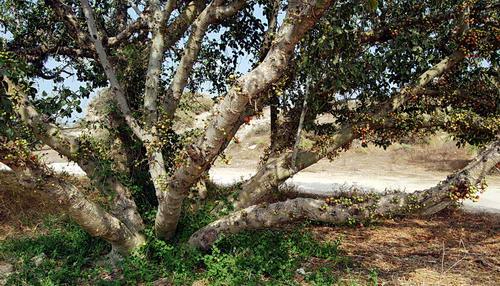

To harvest the fruit of the sycamore fig tree, the farmer must keep the tree free of frost and then prick the fruit, with a hooked knife, 3 or 4 days before collecting the fruit. https://www.hort.purdue.edu/newcrop/Hort_306/reading/Reading%2010-2.pdf.
Jewish texts and commentaries say leprosy looks like “frost” on the skin and, in ancient times, it was thought to be caused by gossip (Numbers 12:10) https://www.huffingtonpost.com/levi-benshmuel/spiritual-leprosy-are-you-afflicted_b_1871378.html
Christians may recall from John’s Gospel chapter 19:34, how a military person (a vogt) https://en.wikipedia.org/wiki/Vogt) pierced Jesus’ body as it clung to the Tree, 3 days before it bore fruit and appeared alive in the garden of the tombs.
Today as then, stories enrich our lives and communities. A well told story or memoir embellishes the truth to help people grow in human understanding. The Sycamore Tree, like the Tree upon which Jesus hangs has been used to keep people content with poverty and willing to sacrifice their lives. The death of Jesus of Nazareth and the releasing of Jesus Barabbas (Matthew 27:17) has been described in military terms as if nailing or tying down the confirmed bachelor of Mary’s hometown to a Tree that is like a vine bearing lots of fruit (psalm 128:3) and the releasing of a renowned resistance leader would start a revolution that would end in a horrific apocalypse.
Writers and stain-glass window makers have done a great job of convincing Christians that the Cross and the Crucifixion was a violent and horrific reality. It is almost impossible for modern believers to see the Cross and the Crucifixion story as a love story. It sounds like nonsense. Violent and horrific deaths occur when people go to war or seek to punish, torture, and kill people who the moral voice or majority feel are unworthy. So the belief persists that Jesus accepted death on the Cross as a historical reality in the same way as criminals in ancient Rome were tortured and put to death.
However, in Jewish tradition, when a bachelor gives himself in marriage, he is reborn. To be reborn, he must die to his old life. As a symbol of his readiness for marriage, a bachelor who has taken a Nazarite vow would shave his head. He would look like a skull! (Numbers 6:18). A Nazarite is not even allowed to drink vinegar, or grape juice, let alone real wine, until he has shaved his head and presented 3 peace offerings, a lamb, an ewe, and a ram.
Before Jesus of Nazareth is firmly committed to the Cross, a soldier or a person with a name synonymous with soldier (https://en.wikipedia.org/wiki/Vogt) offers him a hyssop stick that has been soaked in bitter wine. He refuses to drink this bitter wine.
The names of the characters in the Gospels confuse many people and scholars do a diligent job of presenting the characters as if they are many separate characters rather than names and words ascribing characteristics to the principle characters.
It is no wonder devoted Christians all over the world, release Jesus Barabbas from prison and then fail to see him as Jesus the “Good” Teacher also known as Nicodemus who looked at the rich little person and loved her (Mark 10: 17-21) and visited with her the red-headed female Jesus under the cover of darkness (John 3: 1-21; Luke 19: 1-10) and met her again at the Well (John 4) and then face to face in the garden of the tombs (John 10: 11-18) where she realized Jesus the Teacher was not the Gardener and the Father of the Law and Oral Tradition, but the Son (Mark 15:21; John 20: 15-17).
Moreover, it is not surprising that devoted believers without the benefit of speaking several languages then reject Jesus the Nazarene as her Bridegroom, her Stag, the Hart and Cornerstone of the Gospel, the “sweetheart’s” stone, “Jo’s” cephas, who takes her for his wife, the most blessed of all women (Luke 1:42; Matthew 1:20), the Ariel Gazelle, the Bride of Song of Song of Songs and Psalm 45 to fulfill the Hebrew Testament promise (Micah 4:8; Isaiah 62: 3-5); Song of Songs 8:12-14; Acts 4:11; Acts 9: 36-42).
These are the last days and it is time for Christians to realize the little person climbing up and down the Sycamore Tree accepted Jesus’ request to spend the night, to stay, at her house. She did so of her own free will. She even climbed up the Tree to increase her stature, her social standing, so that she could meet him.
Down through the centuries, many people have been sexually abused by people with authority in the Bible and in the Church. The abused may have accepted their advances willingly. But their willingness does not make the authority figure, the Jesus figure, clean and them dirty. Each time Christians insist, the little person of Luke’s Gospel is the dirty one and the visiting Teacher is the clean one, they are keeping salvation from being realized in their house.
*Jericho is the city in which Rahab lived and owned a house. As the story goes, Rahab was a “sinner” woman, a woman who was generous with her hospitality. And so, biblical tradition and righteous people call her a whore, yet James 2:25 claims she was justified by her hospitality.
Discover more from Linda Vogt Turner
Subscribe to get the latest posts sent to your email.
 Linda Vogt Turner