Most people know the Bible begins with, “In the beginning…” but far fewer have paused to notice the Third Day.

On the Third Day of Genesis, God spoke and established the land, the seas, the plants, and the trees — the foundation of life itself.
On another Third Day, long after Genesis was written, something else happened in a garden.
On the third day after Jesus was nailed to a tree and then taken down from the tree and buried, the Woman Jesus called Mary the Magdalene came looking and watching for the promised Bridegroom, the Rabbi called the Forerunner had testified about. The Tomb in a Garden of tombs was empty except for two angels in white sitting where the body of Jesus had lain, one at the head and the other at the feet.
Those guarding this Tomb down through the centuries have said. “What kind of ‘fake news’ is this?”
There is some truth to that question, suggesting that this story is fake, not quite what one assumes when one first looks into the tomb the guards are watching over.
Joseph and the Teacher of Israel both wrapped the body of Jesus in clean linen sheets and buried the body, within a stone cavernous body of Joseph’s making. Scripture records how the Woman Jesus called Mary Magdalene — and the Mother of Joseph — knew where the body of Jesus lay. But don’t be fooled by the title Mother because the Mother belonging to Joseph would be the Woman chosen to be the Mother of his children.
Did not the Baptist say he was not the Christ his disciples were watching and waiting for because the Bride belonged to the Bridegroom — John 3:28-29.
Are you listening thinking like Simon the Cyrenaic (man of worldly thinking)? Simon was chosen by Jesus as the Building Stone of the Church, tradition claims is the Bride who belongs to the Bridegroom.
Yet Simon — Peter, the Rock — balked when Jesus declared that the path led to Jerusalem, led to suffering, to death, and to rising on the Third Day.
Simon very adamently told Jesus that this would never happen and even called Jesus, Lord!
- Peter took Him aside and began to rebuke Him. “Far be it from You, Lord!” he said. “This shall never happen to You!”
Now you may be hearing the words Him and Lord and thinking: Clearly. Jesus is Male. “He who has ears to hear, let him hear.” Don’t let Patriarchal Language keep you in the dark.
Simon is in truth, rebuking the Woman Jesus — the one who had just chosen him to be the Father of a godly family. His words drip with sarcasm. He mocks her for daring to think that she, a woman, could claim such authority for herself and for him.
Suicide! he thinks. They plan to kill her. Does she not understand?
Yet the Woman Jesus trusted the word of her sister Martha’s Lord, who once said:
- “Mary has chosen the good portion and will not be taken from her”—Luke 10: 42.
In Greek, the word “portion” is meris — not just a fragment, but a meritorious share, and inheritance that endures. That inheritance is what the Woman Jesus claimed, even as Simon mocked her.
Then the Woman Jesus turned and said to Simon the Cyrenaic — the Black Rock:
- “Get behind Me, Satan! You are a stumbling block to Me. For you do not have in mind the things of God, but the things of men.” —Matthew 16:23
Yet Jesus the Woman did not leave the matter there, but added:
- “If anyone would come after Me, let him deny himself and take up his cross and follow Me. For whoever wants to save his life will lose it, but whoever loses his life for My sake will find it” —Matthew 16:24–25.
Later, what appears to be another Simon is named — Simon of Cyrene (Mark 15:21). The word Cyrenaic carries a double meaning: not only a man from Cyrene, but also a hedonist, one who seeks pleasure and avoids suffering. In this light, Simon the Cyrenaic truly was “thinking as men do,” worldly and unwilling to accept the Woman’s call.
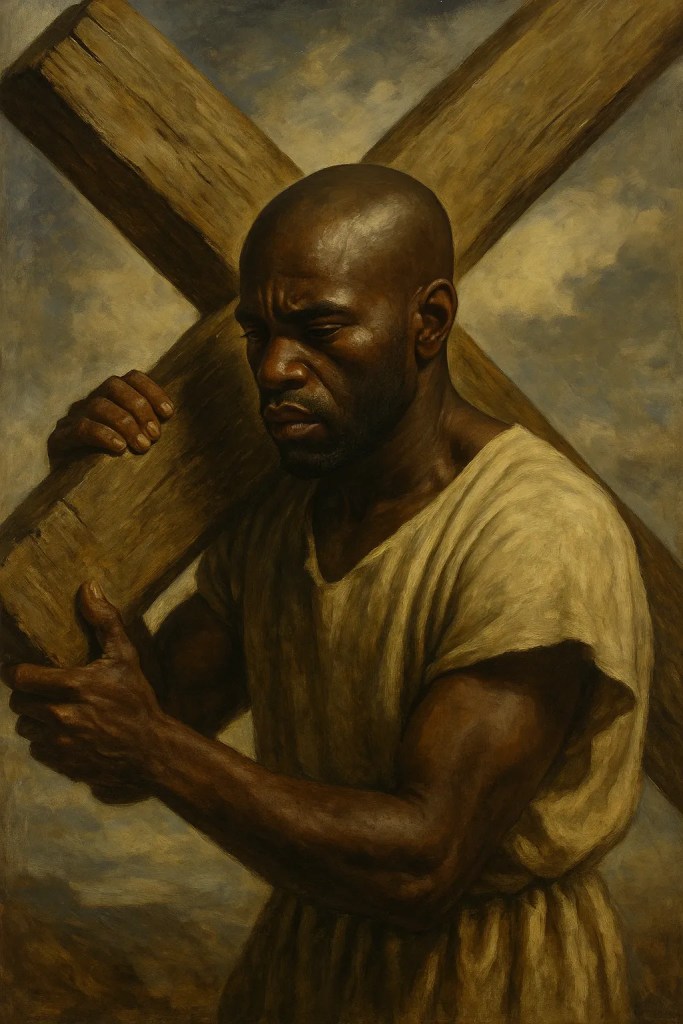
Yet the mystery deepens: it is this same Simon who is compelled to take up the Cross. The Black Rock, once resistant, becomes the very one who shows what Jesus had promised — that in denying worldly pleasure, in taking up the Cross, one finds life on the Third Day.
Joseph and Simon are not two but one — the Everlasting Father whom the world calls by many names.
Jupiter was named the God of Thunder, and it is Thunder and Lightning that bring fire and cause the mountain to shake on the Third Day. This is the heart — and the cause — of the Third Day.
For the Third Day fulfills the Word of God, bringing back to life the Jesus whom worldly thinking seeks to silence — nailed to a tree uprooted from her roots — yet bestowing eternal life to those in the tombs.
The Orthodox Church sings this truth each week in the Hymn of the Resurrection:
- Christ is risen from the dead, trampling down death by death, and on those in the tombs bestowing life!
The hymn is not just a song of triumph — it is a declaration of hope in God’s power, which sweeps away false beliefs and fills humanity with incomparable hope.
Do we believe it? Or do we stumble at the very idea of taking up a Cross? Do we reduce it to soldiers and temple police nailing people to beams of wood? Or do we see the essence — the fragrance — of the Cross? For in dying to the world’s way of thinking, the breath of resurrection is given, bestowing eternal life on the Third Day — John 20:22.
Do dead people come out of their tombs and walk and talk and teach others? Scripture says yes.
Peter and John stood in front of the Gate called Beautiful and said to those crippled by worldly thinking:
- “Look at us. Silver or gold I do not have, but what I have I give you: In the name of Jesus Christ of Nazareth, get up and walk!” —Acts 3:6
What caused Peter and John to stand there? What caused Peter to declare:
- “Therefore let all Israel know with certainty that God has made this Jesus, whom you crucified, both Lord and Christ!”—Acts 2:36
John’s role is often overlooked. Many still see him only as the Baptist who lost his head in prison. But John is also Jesus the Forerunner — Hebrews 6:19–20 — the Prince of Peace foreshadowed in Isaiah 9:6. Thus, with Peter — Christ the Everlasting Father, the Bridegroom of the Mother of God — John stands reconciled to him, not merely as a companion but as the right hand, the trusted friend, the one through whom victory is given to the people (Niko–demos).
The mystery is revealed when Jesus breathed out on the Cross, saying:
- “Father, into your hands I commit my spirit.”
The Spirit entrusted is not lost, but received — into the Father’s hands, and into the hands of those chosen to guard both Gate and Tomb.
John, the Forerunner, stands as the friend of the Bridegroom; with Peter — who, having now declared his love for Jesus, becomes Christ the Everlasting Father.
Together Peter and John guard the Gate called Beautiful, bringing victory to the people.
In the mystery of the Third Day, John too comes alive again — as Moses, as Nicodemus, as the Teacher of Israel who prepared the people in the wilderness to meet God.
This Teacher knows the voice of God in thunder, and he knows that God’s eternal partner is lightning — lightning that can kindle wildfires, strike coal seams alive with fire, and keep the earth in electrical balance.
So do we stumble when Jesus says, “Take up your cross”? Do we reduce it to soldiers and temple police nailing people to beams of wood? Or do we hear what Moses heard at the bush that burned but was not consumed?
What if we turned back and listened to the Teacher of Israel?
He was the one who first heard the voice from the Burning Bush on the Mountain of the Lord — the bush aflame yet not consumed. At first, he felt unqualified to speak. He had killed a man. Yet he answered the call. He brought the Israelites out of Egypt, and for forty years in the wilderness he prepared them to meet God on the Third Day.
And how would he prepare them/us? With the Genesis Creation Story?
So turn with him, turn with me, back to the beginning. On the Third Day, God spoke — and the seas, the plants, and the trees came into existence. Think about this: God’s speaking breathed out carbon dioxide. Carbon dioxide is a form of carbon. And carbon is the building stone of all life. Without carbon, nothing on earth would be alive.
Thus, in Genesis, in the account of the Third Day, Moses the Teacher of Israel made an extraordinary observation: that the very element which holds life together — the same element many today see only as a threat — is the sign of God’s creative voice.
The Teacher told the people of Israel, and all who followed him out of Egypt, how God’s energy hovered over a dark, watery abyss and brought forth sound and light — together like an eternal couple, thunder and lightning. And out of that union the world was set in place, resting on a framework of seven days and seven nights of 1200 hours — sealed with the promise of the ark’s rainbow —and from the Mountain of the Lord, the rainbow can be seen as a perfect circle, an eternal covenant.
- First Day: God Spoke saying let there be Light and then God called the Light Day and the Dark Night.
- Second Day: God Spoke again and established the Sky and the Sea.
- Third Day: Dry land, seas, plants, and trees were created.
- Fourth Day: The Sun, Moon, and stars were created to mark seasons, days, and years.
- Fifth Day: Sea and flying creatures were created.
- Sixth Day: Land animals and humans were created.
- Seventh Day: God blessed it and made it holy — the framework of time, a measure of the earth, given as blessing.
God’s First Ecumenical Environmental Charter: The Ark
The story of Noah’s Ark is often reduced to the image of a big wooden boat. But the deeper truth hidden in the measurements is that the Ark was never just a boat — it is a symbol of the whole inhabited earth.

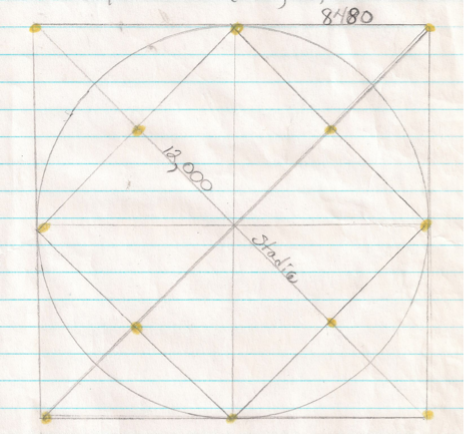
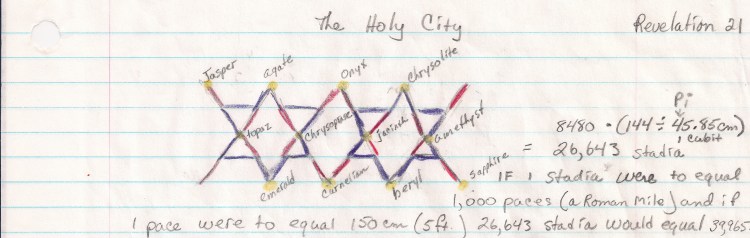
Genesis 6:15 gives the Ark’s dimensions: 300 cubits long, 50 cubits wide, and 30 cubits high. Instead of treating these as separate numbers, I added the breadth and height to the length, arriving at 380. Using the larger cubit of about 20 inches, the result was 7,600 inches. This number became the key to drawing not only the Ark, but also the hexagram and pentagram that frame it — resting on the mountain peaks, joined by the olive twig, and sealed with the rainbow of God’s covenant.
When I drew a square around the rainbow, the diagonal measured 12, and the circle’s diameter came to 8.4. What emerged was astonishing: by reworking the Ark’s measurements through simple arithmetic, the story points us toward the actual circumference of the earth. The Ark, like creation itself, carries within it the measure of the world — about 40,000 kilometers.
Even pi, that number we’re told the ancients didn’t have, is woven into the text. Dividing 144 by a cubit of 45.72 cm yields 3.14. The numbers are there for anyone with eyes to see.
This is why I call the Ark God’s first ecumenical environmental charter. It is not a children’s fable about animals in a boat; it is a revelation that creation is measured, balanced, and preserved within the covenant of God. The rainbow is the sign of this covenant — not only with Noah, but with every living creature.

Exodus 19: The Mountain Shakes and the Teacher of Israel is called to Ascend
Long before Israel stood at Sinai, people of every culture watched the skies and tried to understand the powers above them. The Egyptians worshipped the Sun as the supreme creator. The Greeks and Romans saw Jupiter, the storm-god with his swirling red spot larger than earth, as the Father of the gods.
Modern science now tells us that the Sun and Jupiter were formed together from the collapse of the same primordial cloud. Jupiter’s massive gravity still acts as a gatekeeper, deflecting many comets and asteroids from striking earth — though not all. This “gatekeeping” echoes Simon Peter’s role in the Kingdom of God.
- “And I tell you that you are Peter, and on this rock I will build My church, and the gates of Hades will not prevail against it. I will give you the keys of the kingdom of heaven.”
More Science also tells us that lightning and thunder are born of energy building within a dark, watery abyss. A bolt of lightning superheats the air until it explodes; the shockwave becomes thunder. Lightning strikes can ignite trees; even coal can roar like thunder when struck by lightning on the surface or at mine entrances.
Thunder may not seem to serve a purpose beyond warning us, yet without it the earth would lose its electrical balance in minutes. Thunderstorms replenish what the constant flow of electrons drains away; without them, creation itself would unravel.
All of this becomes a backdrop for Sinai. On the festival of the Third Day, the Teacher of Israel — Moses, as the Egyptians had named him — brought the people to the mountain where he had first seen the bush ablaze but not consumed.
The mountain itself was wrapped in smoke and fire. Lightning flashed. Thunder roared. The blast of the ram’s horn grew louder and louder, and the whole mountain shook violently — Exodus 19:16–18.
And yet — while the people trembled below — Lightning flashed again, and Thunder answered. Moses was called upward. He ascended. He stepped into the thundercloud with lightning flashing, to speak with God, and God answered him in the thunder — Exodus 19:19–20.
You might think Moses was a brave man. But this was not the first time he had ascended Sinai. Before he was called to go and liberate the Hebrew people from the idolatry practiced by the Pharaohs in Egypt, he had already encountered God in the bush that burned but was not consumed. Orthodox Christians call this the Unburnt Bush and claim it is the Icon of the Mother of God, while her Son is the Power and the Father the Most High.
Six chapters later, after speaking with God and hearing Him answer in Thunder, Moses is once again on Mount Sinai. This time, the Lord instructs the Teacher of Israel to hammer a golden lamp from a single unit of gold, in the pattern of a blooming almond bush, with a main shaft and six branches. This Lamp Stand was to be set apart as Holy, and kept lit day and night with olive oil furnished by the priests serving in the Holy Place of the Tabernacle — between the Holy of Holies and the Court of the Gentiles where Jesus taught —Exodus 25:31–40.
For the Hebrew people, the Golden Lamp Stand symbolized the Tree of Life in the Garden of Eden; for Christians it foreshadowed Jesus as the Light of the World. In Greek, this almond-branched tree is the Amygdala — hammered from the most precious metal to manifest God’s eternal presence and the Hope found in trusting that God is watching to ensure His Word is accomplished —Jeremiah 1:11; Isaiah 11:1.
Yet the disciples did not understand what Jesus meant by the Third Day. They assumed it meant He would be silenced as all dissidents were: imprisoned and executed according to political custom. Under Roman rule, that meant being nailed to wooden beams — trees cut and fashioned into crosses to display defiance crushed. Crucifixion was seen as the ultimate sacrifice that inspires courage. But is that Godly thinking? Or is it still worldly thinking that silences Jesus and keeps Him from rising — from ascending — on the Third Day?
Simon thought like a man, not like God, when he refused to believe that Jesus must go to Jerusalem, be tested by the priests and scribes, and be put to death on the Third Day.
Now on the Third Day, the Woman Jesus — the Almond Tree, the Amygdala — lay wrapped in the linen of Nicodemus and Joseph, buried in the cavern of their stony hearts. They had desired her and kept their love for her a secret, but now they shut her out, as if they knew her not. Yet when the stoney heart of Joseph’s making was shaken by angels and shepherds, the secreted love of these two men became more evident — except to the Woman Jesus called the Magdalene, when two angels told her that Jesus of Nazareth was no longer buried.
In tears, the Woman Jesus humbled herself and approached the Teacher in the garden of tombs, supposing she had been wrong about Peter, the one she had chosen. Seeing the Teacher watching over the Garden, she supposed he was the husbandman who had taken her Bridegroom’s place. But as she turned at the sound of his voice, and he said:
- “Do not cling to me, for I have not ascended to the Father.”
She hears Joshua’s voice echoing to Israel when they were about to enter the promised land:
- “Cling to the Lord as you have always done to this day.”
Her empty heart and soul began to fill with joyful expectation. She realized she was going to raise a divine family and establish a new covenant. Her Husbandman was not dead, sitting on a throne in the sky. He was down by sea, a little shaken — trying to stand after a long night in the dark, and walk the talk on ankles strong enough to bring her out of the sea as the Tangled Catch of the Day.
The Heart of the Third Day
Now as the Creation Story, the Resurrection Story, and the Second Coming are mocked and dismissed as Fake News, I prepared this blog to invite you to turn back and listen to the Third Day ascension of the Teacher of Israel, the Egyptians named Moses.
The Third Day Ascension Event in Exodus demonstrates the Teacher of Israel’s power as the Son of God, born again and reconciled to God the Father with the Woman Jesus called the Magdalene — the I AM who is The Light of the World, the Gate, the Resurrection and the Life, the 153 Fish, the Womb of Life.
Peter, the Black Rock, is her Bridegroom — the one given the keys, whose love, whose gravity, like Jupiter’s, guards the covenant and keeps the gates of Hades from prevailing. And John, who kept watch under the cover of darkness, is Jesus the Forerunner who testifies that the Bride belongs to the Bridegroom — John 3:28–29.
Together Peter and John stand at the Gate called Beautiful, and Peter takes the lead, saying to those crippled by worldly thinking:
“Look at us. Silver or gold I do not have, but what I have I give you: in the name of Jesus Christ of Nazareth, rise and walk.” (Acts 3:6)
The keys are in Peter’s hands, offered to all. Yet only those sons and daughters with the power — with eyes to see and ears to hear — will take them. They will link arms with Jesus the Forerunner and walk the talk, honouring their Mother and their Father in Christ and receiving the promise: to live long in the land.
Discover more from Linda Vogt Turner
Subscribe to get the latest posts sent to your email.
 Linda Vogt Turner