
Christmas hymns such as We Three Kings — with lyrics such as “Star of Wonder, Star of Night” — have long shaped the Christian imagination.

star with royal beauty bright,
westward leading, still proceeding,
guide us to thy perfect light.
Children’s songs such as Twinkle, Twinkle, Little Star, and even the familiar wishing rhyme — Star Light, Star Bright, First Star I see Tonight… — invite wonder and trust.
Through song and rhyme, children — and adults — are encouraged to look up, to hope, and to trust in God’s guiding presence and messianic promise.
Like The Twelve Days of Christmas, these simple songs carry more than sentiment. They help people remember a journey — not of one Magus, but three — watching, travelling, and bearing gifts to help birth and sustain a Divine Kingdom on earth. A Kingdom envisioned by St. John the Divine as the Holy City, radiant with light (Revelation 21:1).
With that in mind, here are a few star-facts drawn directly from the Bible — not as fantasy, but as patterned meaning.
Esther, whose name means Star, saved her people not through force, but through wisdom, timing, and restraint. By keeping her Jewish identity hidden, she exposed Haman’s murderous plan at a banquet, turning the fate of her people at the appointed moment.
Although Esther’s story is told many generations after the Flood, it carries the same mathematical and theological pattern found in Genesis: six days of action that rest upon — and depend upon — the timing of the seventh. At the climax of Esther’s story, Scripture says the Jews obtained rest. The Hebrew word for rest, נוֹחַ (nuach), is pronounced Noah. This is not coincidence. It is God’s reliable pattern.
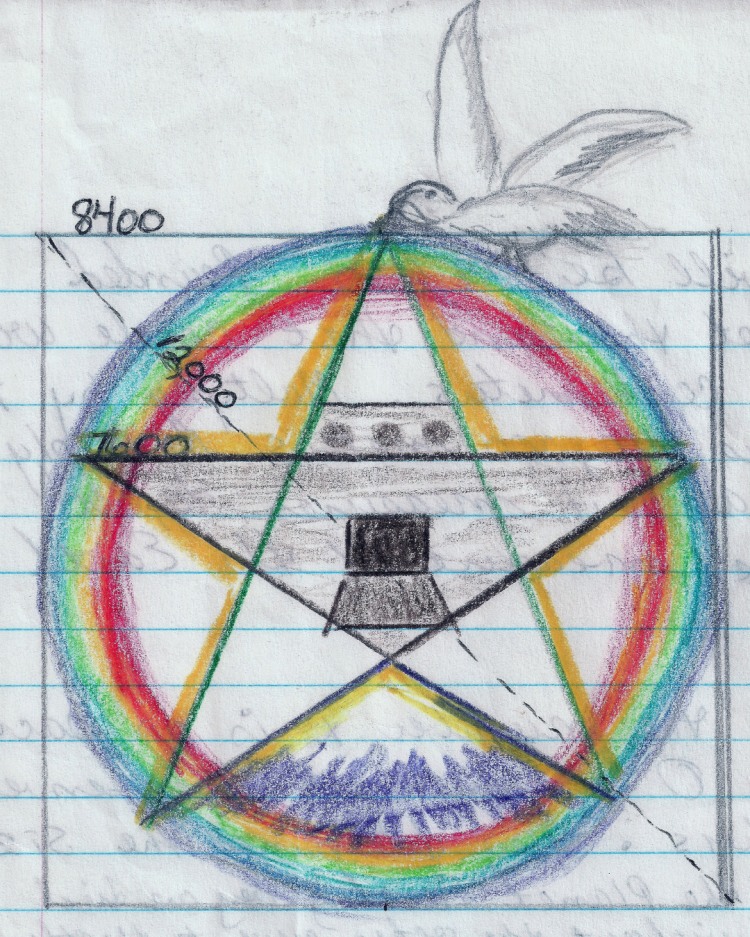
For readers who wish to explore this pattern more deeply, a full mathematical and theological reflection is available in my paper The Mathematics of the Holy City which examines biblical geometry, timing, and light in relation to Scripture and Revelation.
A Hidden Identity in Plain Sight
In the New Testament, the Pauline author writes, “I have been crucified with Christ; it is no longer I who live, but Christ who lives in me” (Galatians 2:20).
What is often missed is how this author’s female identity was hidden in plain sight in the ancient world, not only through male grammatical convention, but through the biblical mystery of marriage itself — where two become one new man, a phrase the Pauline author uses deliberately to describe male-female unity through covenant, a mystery said to refer ultimately to Christ and his Bride (Ephesians 5:31–33).
This same mystery is affirmed by the Forerunner called John in the Johannine community, who insists that Christ is the Bride, belonging with and to the Bridegroom (John 3:28–29). In the book of Acts, when Paul speaks publicly in Greek cities, the crowds hear a heavenly messenger…travelling and speaking with Barnabas’ encouragement.
In Acts 14, the crowd names Barnabas Zeus, and Paul Hermes (the chief speaker) —the Roman equivalents being Jupiter and Mercury—as if thunder and his lightning swift messenger were walking among them in human flesh.
In the first century, Mercury the smallest planet was seen as a twinkling star — small, swift as lightning, appearing at dawn and dusk.
Jupiter, by contrast, shone steadily and brilliantly — the largest planet and most authoritative light when rising in the night sky —protecting the planets from comets.
Lightning and Thunder: ascending the holy mountain, Moses spoke with God, and God answered him with thunder, amid smoke and fire caused by the Lightning (Exodus 19:16-19).
Discover more from Linda Vogt Turner
Subscribe to get the latest posts sent to your email.
 Linda Vogt Turner