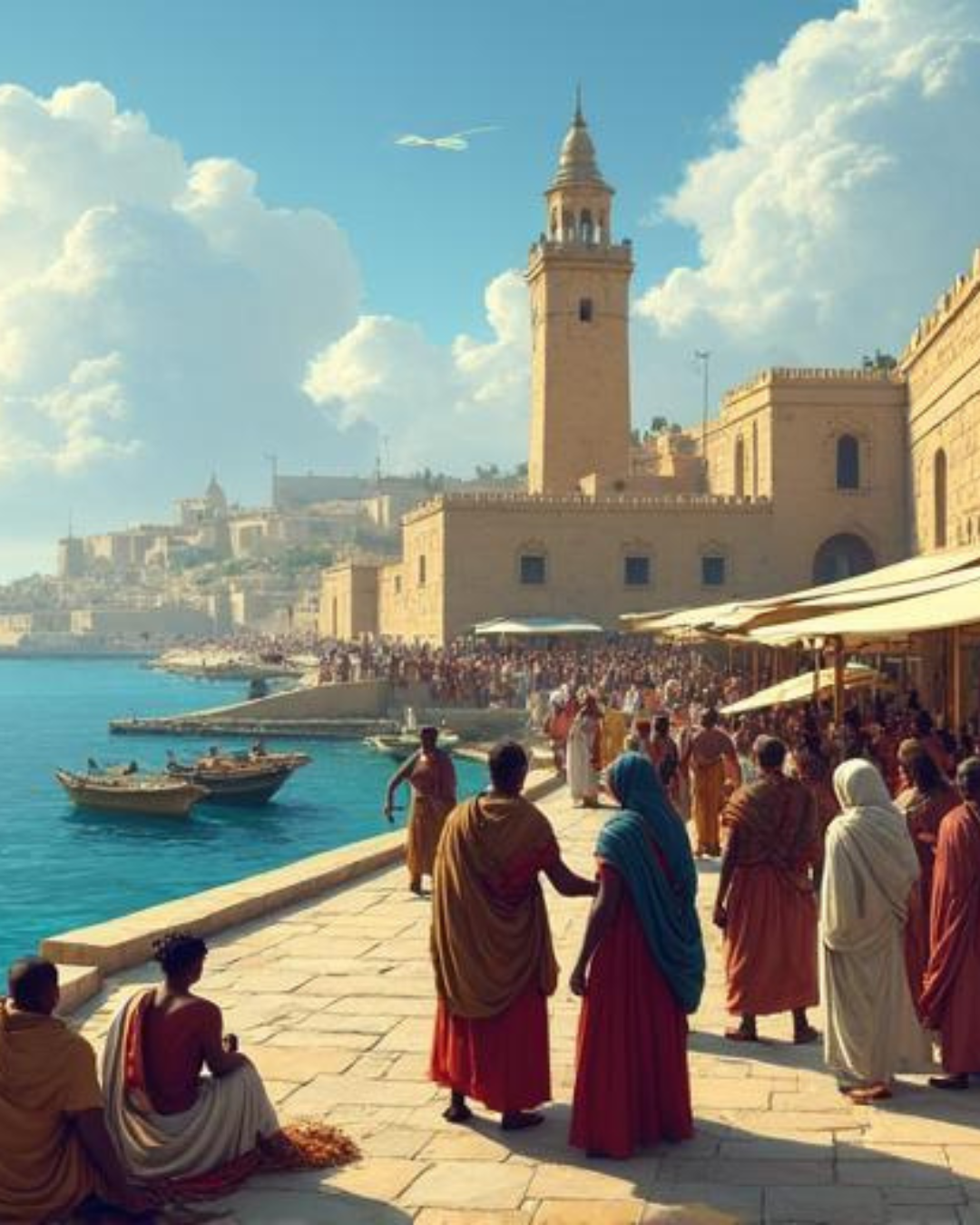
The journey to Egypt made by Mary and Joseph is often imagined as a flight into obscurity, a way of avoiding notice. But the story itself suggests something different. They do not flee to Egypt to disappear. They flee there to be received —to be loved, seen and heard.
In Bethlehem, Mary and Joseph are received and given accommodation in a cave — a place some describe as a barn, ill equipped to provide true hospitality. Here, as visitors from the East arrive in the first light of dawn, following a star, they bestow gifts to celebrate the birth of a Holy Man, a Holy Family, as foretold in the Law, the Prophets and the Psalms.
Yet news of this Holy Family — birthed into the world as God’s only begotten — disturbs the status quo. Scripture tells us that when word of a Holy Man, vulnerable as a newborn child, reaches Herod’s ears, he orders — or legally permits, through laws already in place — the killing of all newborns under the age of two. This killing of the innocents was likely carried out by exposure, a common fate experienced by unwanted babies in many cultures at that time, and since.
In Jewish culture, the family — rather than the individual — is the smallest human nucleus. The family therefore begins on the day of the wedding, witnessed and conducted by the rabbi. (see Marc-Alain Ouaknin, Symbols of Judaism, Assouline Publishing, New York, 2000).
In Egypt, the Holy Son goes swiftly into the East — into a world where story, song, and memory are already ancient, where faith is carried not only in texts, but in music, movement, and shared imagination.
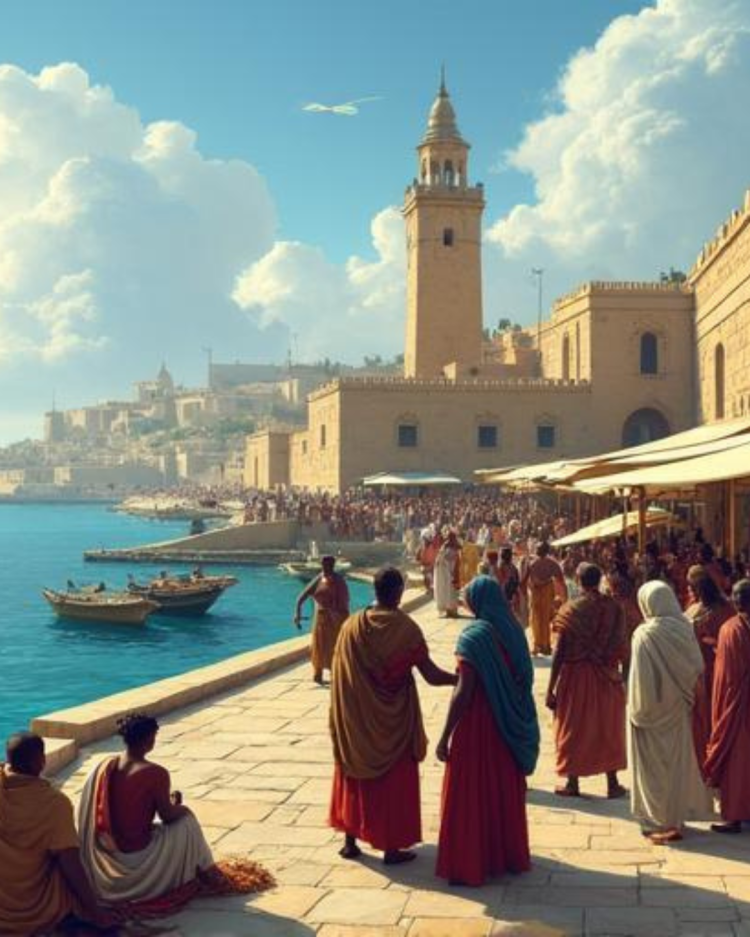
So why Alexandria? Why would the Holy Family hurry toward a city — or a place named for a Greek called Alexandros, and not some other place in Egypt?
Perhaps here, what was new would have been recognized as old. A newborn love, coming alive according to prophecy, would have been embraced as an ancient man-child — welcomed, encouraged, and drawn into conversation. This love would have been lifted up by elders who knew how to carry truth in story, and by age-old friends who understood how love grows strong through walking, talking, and shared life.
In this way shared life, an ancient love coming alive would have become a mirror, as if catching the light of the sun to illuminate what had long been planted in the human heart. As this love was shared, it would dwell among a community capable of providing the hospitality such ancient love needed.
Scripture provides glimpses of truth that support the notion that the Holy Family, after the wedding in Joseph’s hometown, went to Alexander’s city — place. Granted, Alexander’s place may not have been the famous city on the Delta. What matters here is not geography alone, but what such a place represents for the faith journey.
The story told in Acts 18 names Alexander’s place as the place of the nativity of Apollos. Granted, the name Apollos recorded in Acts and in the Pauline Letters may not originally have included the final “s.” Nevertheless, the name Apollos — as recorded in Acts 18:28 — means “of Apollo.”
According to widely available historical accounts, political propaganda placed the head of Alexander on one side of a copper coin, with the head of Apollo on the other. In this way, Alexander’s victories were rendered sacred—for he was deified as Apollo, the one who brought Nikē to the dēmos, to the people. This imagery circulated prior to Rome’s rise to power, serving to keep peace when necessary through military strength amid competing Greek, Roman and Arab states.
For those well acquainted with the Gospel story that places the Baptist’s head on a copper plate, it becomes possible to see why early Christians might have linked John the Baptist with Apollos.
This linking of Apollos as a native of Alexandros’ place or city may also have sparked the Pauline question and answer: What then is Apollos? What then is Paul? but servants. (1 Corinthians 3:5).
Further to the scriptural claim that Alexander’s place was the nativity, the birth place of Apollos is the description of Apollos as a learned man who knew only that of John the Baptist. Curious to this little seed of information is the fact that the Pauline author’s question and answer — What is Apollos? What is Paul? but a servant — is joined to the claim that Apollos waters the seeds of the Gospel planted by said author.
Now many will protest, saying but the Pauline author never met Mary or Joseph, let alone the child brought to Bethlehem, the place of Christ’s Nativity, begotten from Mary’s womb.
Yet, Alexandros’ place — whether the famous city of Alexandria or another place bearing Alexandros’ name where the Dawn meets the Sun — the fact remains: the fruit of Mary’s womb, the seed of her womb, needed a place where what was planted in the dawn could thrive in sunlight.
Two further details need to be added so that the watered seeds of Apolline and Pauline cultivation are seen to germinate with God the Father —who supplies the increase. Additional servants are necessary, one being Joseph who accompanied the Pauline author to the Greek and Roman cities of Lystra and Derbe. For Joseph’s name means “he will add” or “the one who brings the increase.”
The second detail adds further light brought in by the Lukan author of Acts who testifies that the Pauline author bore witness to the Jews that Jesus was Christ (Acts 18:5). The same account adds that Apollos vigorously refuted the Jews in public debate, proving from the Scriptures that Jesus was the Christ (Acts 18:28).
The Greek Interlinear text adds still more light here. It presents the Pauline author as bearing witness —to the Jews “to be” the Christ Jesus—who the prophet Isaiah identifies as the suffering servant (52:13 —53:12).
While the Pauline author is doing this, in the same chapter of Acts, Apollos is also proving “to be” the Christ Jesus — in keeping with Hebrews 6:19-20 which identifies the Forerunner as Jesus.
Too much light can be blinding and crippling, especially for those who have been born and kept in the dark.
This is the first in a series of Epiphany reflections. In the next post, I turn to the healing of the man crippled from birth.
If you would like to receive the next blog post, you are welcome to subscribe here.
Discover more from Linda Vogt Turner
Subscribe to get the latest posts sent to your email.
 Linda Vogt Turner