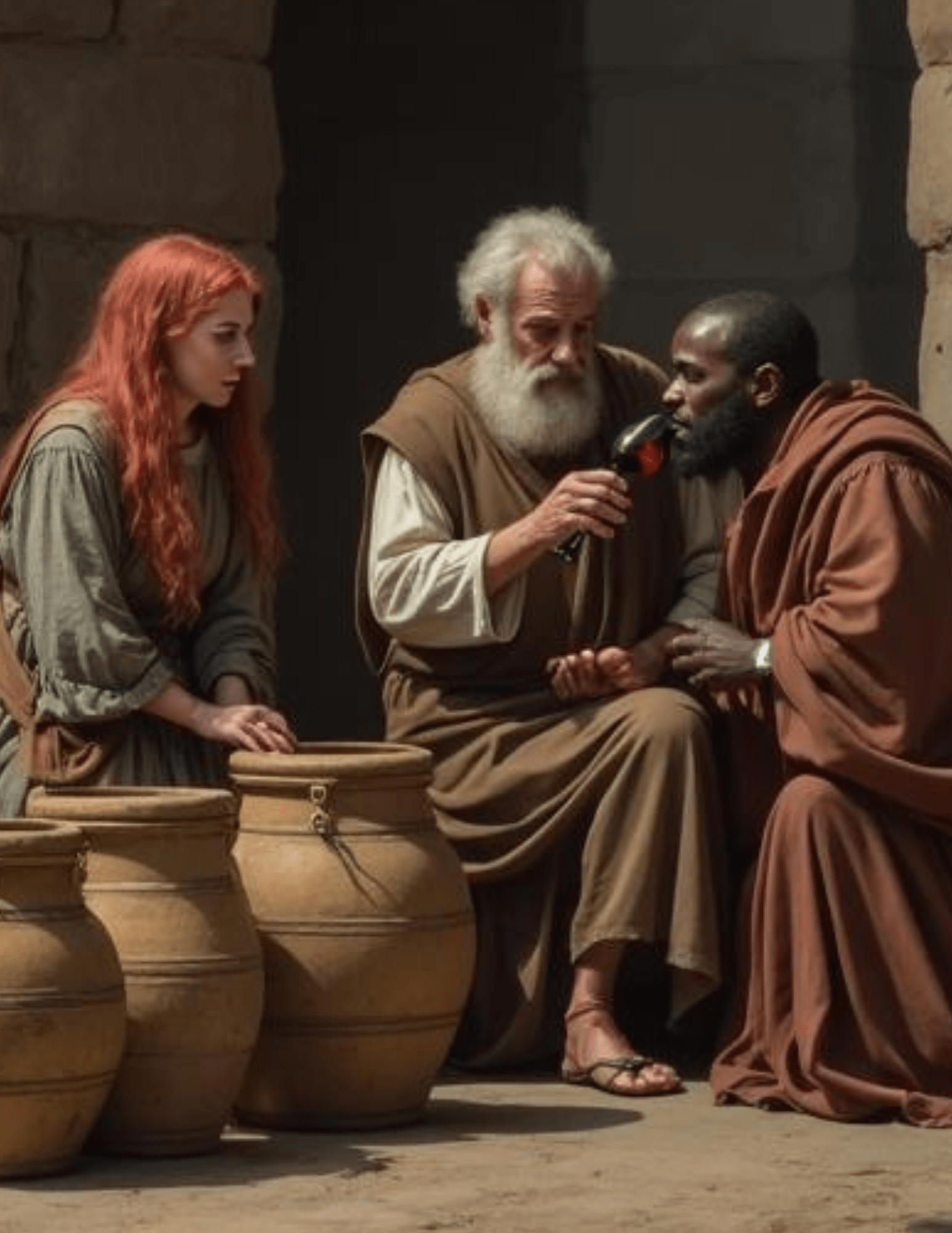
On the third day a wedding took place at Cana in Galilee. Jesus’ mother was there, and Jesus and His disciples had also been invited to the wedding. When the wine ran out, Jesus’ mother said to Him, “They have no more wine.”
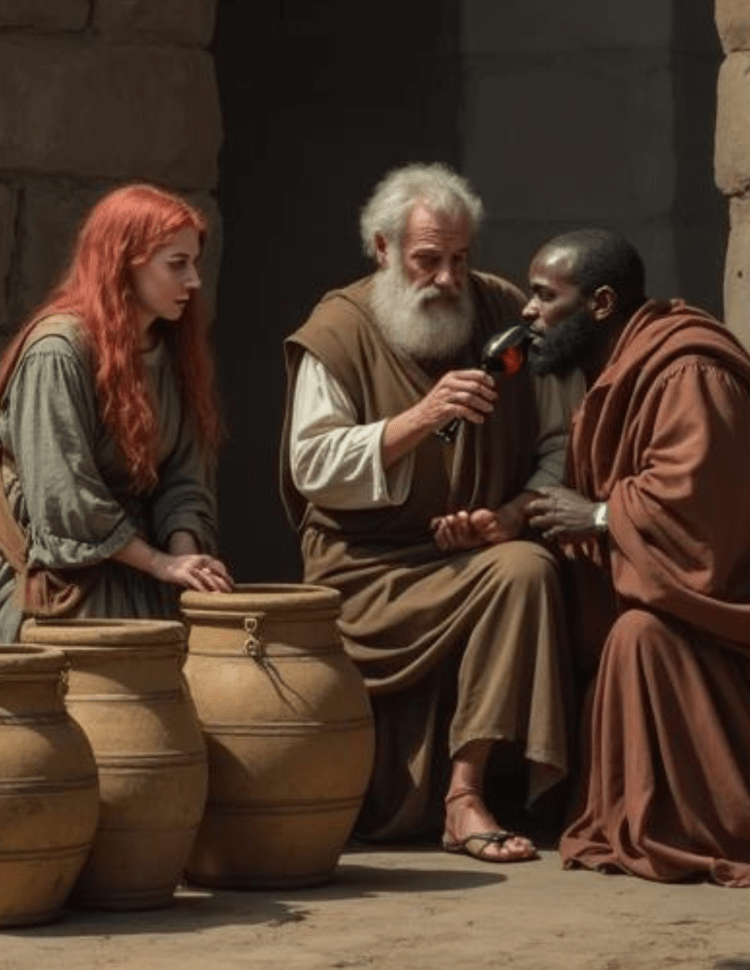
“Woman, what is that to you and Me?” Jesus replied. “My hour has not yet come.“
His Mother said to the servant, “Do whatever he tells you.”
Now six stone water jars had been set there for the Jewish rites of purification. Each could hold from twenty to thirty gallons. Jesus told the servants, “Fill the jars with water.”
So they filled them to the brim.
“Now draw some out,” He said, “and take it to the master of the banquet.”
They did so, and the master of the banquet tasted the water that had been turned into wine. He did not know where it was from, but the servants who had drawn the water knew. Then he —called the bridegroom aside — and said. “Everyone serves the fine wine first, and then the cheap wine after the quests are drunk. But you have saved the fine wine until now!”
Jesus performed this, the first of His signs, at Cana in Galilee. He thus revealed His glory, and His disciples believed in Him.
_____________________________________________
Notice the phrase “called the bridegroom aside.” In the language of Scripture, to be called aside is to be set apart — consecrated. In Middle Eastern culture the Bridegroom is also the Master of the Banquet, the one responsible for the feast. And so here too the one tasting the wine is both the Master of the Banquet and the Bridegroom — the one set apart and taken away or aside in Lent, because he does not yet know the source of the wine. For his Bride is the one who told the servants, “Do whatever my son tells you.”
At the end of this well known story, Jesus’ glory is revealed, and John proclaims that this was the first of His signs at Cana in Galilee. But this raises a deeper question: Who is Jesus? If Jesus is the Bridegroom who judges the wine to be the best wine, how is His Glory revealed?
In Acts 3, Simon Peter and John stand together before the Gate called Beautiful, and Simon says: “Pay Attention.” In John 3 and in Exodus 3, the Teacher of Israel — called Moses in Exodus and Nicodemus in John — speaks with the I AM.
Yet in John’s Gospel, the Teacher of Israel also appears as John the Baptist, the Forerunner.
In Exodus the Unburnt Bush stands as an Icon of the Mother of God’s pure nature as the source — the I Am who is and who will be.
As the fire is seen by the Teacher of Israel, this bush, this little tree is not consumed. The fire within her is not overwhelmed, and this voice speaking with such power is firmly planted upon a magnificent rock called a mount.
In wedding terms, a marriage is consummated when the Bride and Bridegroom share their passion, their fire for each other as man and wife. The Bible calls this a sacred mystery. For when a man leaves his father and mother and is united with his wife, the two become one flesh.
On the Third Day in Exodus 19 there is a feast. In Jewish tradition the events of the third day mark the moment when God descends on Mount Sinai to give the Ten Commandments. This event has often been understood as a spiritual wedding, with God as the Groom and Israel as the Bride.
Yet Moses speaks to God and God answers with thunder, as if calling attention to heaven’s first marriage of lightning and thunder — the creative power that spoke Adam and Eve into being. This Third Day therefor becomes a covenanting — a betrothal ceremony that reminds those gathered for the feast of the importance of the sacrament of marriage.
Pay attention. In Exodus there is thunder, fire and smoke. Every school child knows that thunder and lightning belong together: lightning appears in the sky, and thunder answers. The Teacher of Israel, called Moses by the Egyptians, brings his follower out of the camp to meet God at the foot of the Mountain. As the ram’s horn sounds and grows louder, Moses speaks and God answers him in the thunder.
The LORD descends upon the top of Mount Sinai and calls Moses to the summit. Moses ascends, and the Lord tells Moses to warn the people and priests not to push forward to see the Lord, unless they have been consecrated — set apart — made Holy for a divine purpose.
The Cana story is also a betrothal and the first step of the marriage covenant. Here the Bridegroom is called aside to judge the wine the servants have prepared under the direction of the Mother’s son — the Teacher of Israel — later known by the name Jesus, the son of the Father.
Yet at the end of this story John proclaims that this sign at Cana revealed Jesus’ glory, and His disciples believed in Him. Still this is a puzzle, for in Luke’s Gospel the glory of the Lord shines around the shepherds in Bethlehem on the night when Mary gives birth to Christ.
According to the Pauline author man is the glory of God and woman is the glory of man.
This raises another question:
Is the Mother of God the glory of the Father of God, and is the Cana Third Day event a re-covenanting ritual of their betrothal — at the beginning of the world?
Or is this simply some village wedding that Jesus and his Mother were invited to attend?
In the next chapter, Jesus appears under the cover of darkness with the Teacher of Israel, and people begin to ask the Question:
Who is the Bridegroom?
Is the Teacher of Israel, the Christ?
______________________________________________
This is the ninth in a series of Epiphany reflections paving the way for the Cross. Now in Lent, the next Lenten Epiphany turns to the story of Jesus and Nicodemus under the cover of darkness — and the light this brings to their faith journey.
If you would like to receive the next reflection, be sure subscribe.
Discover more from Linda Vogt Turner
Subscribe to get the latest posts sent to your email.
 Linda Vogt Turner