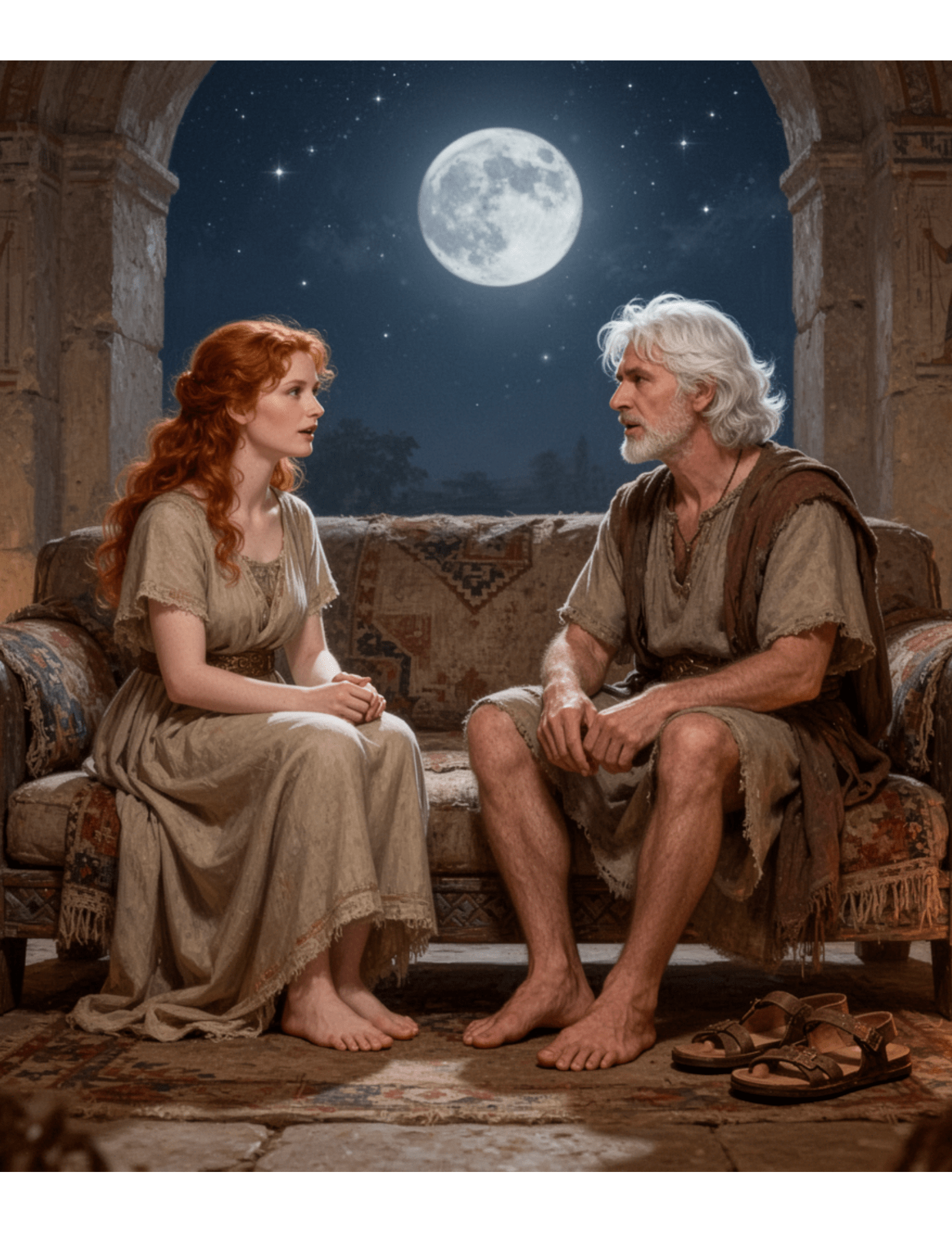
When Jesus and the Teacher of Israel meet under the cover of darkness, some onlookers see and hear what others cannot. Many even today without ever seeing Jesus face to face assume that Jesus must be male.
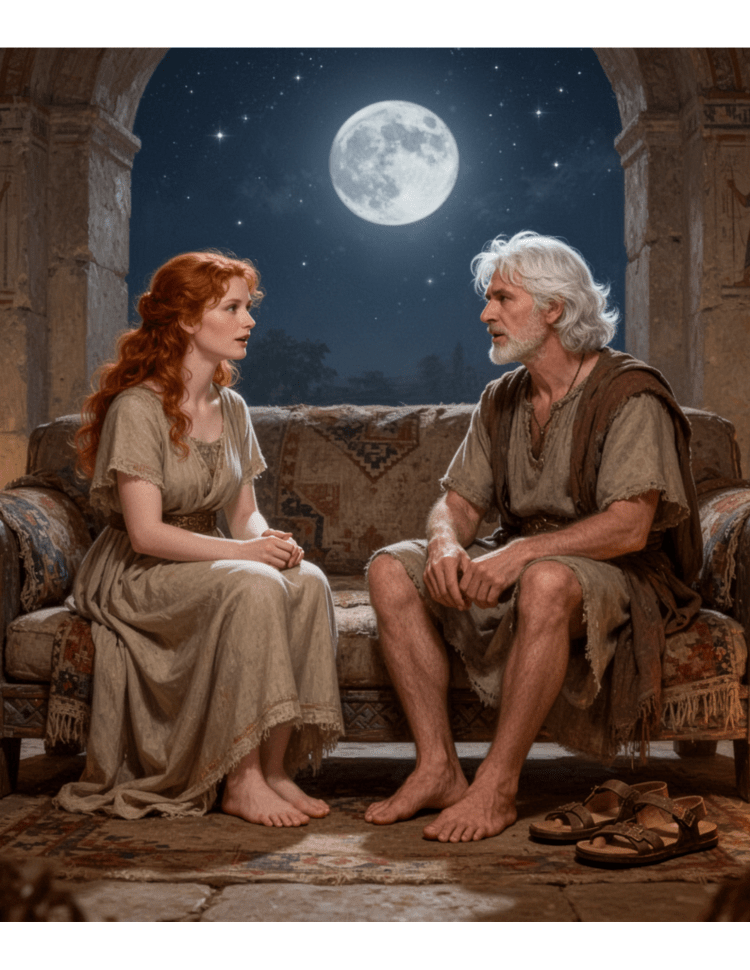
Jesus is always referred to as He. Does the “He” stand for he and she — two people speaking face to face? Many people unfamiliar with the fact that Pharisees such as the Teacher of Israel called Nicodemus (whose name means “victory of the people”) would have believed in the possibility of being born again.
The Sadducees would not have, and the Samaritans were marginalized and excluded by both groups. Thus they were “kept in the dark” by Jewish authorities and by society. The Samaritans did, however, have knowledge of the first five books of the Bible.
No doubt a Samaritan woman would have known that the Teacher of Israel — whom the Egyptians called Moses — was named because he was found in a small basket of straw, set among reeds, and canes in the waters of great river delta. There his saviour was a woman of a royal household who adopted him as her own dear son.
A Samaritan woman would also have thought of the Teacher of Israel as one who brought victory to the people — Hebrews and Gentiles alike, even those thought of as rabble —by freeing them from Egyptian slavery.
So what has the birth of Moses, the Teacher of Israel, got to do with the story of Jesus and the Teacher of Israel meeting under the cover of darkness?
This under cover story comes in the third chapter of John’s Gospel and follows the Cana Third-Day event. In Hebrew, Cana means the place of reeds. At Cana the bridegroom — the master of the banquet in Mediterranean custom — is called aside. Believing the servants responsible for the best wine he has tasted, he praises them. Yet he does not yet know the Mother of Jesus was the wine’s source. The servants know. Those who were present may know. But many who hear the story later remain in the dark.
In Cana, six stone jars had been set aside for the Jewish rites of purification.
Each jar contained about thirty gallons — roughly one hundred and twenty quarts. According to Deuteronomy 34:7, Moses lived to be one hundred and twenty years old. That fact may have nothing to do with the six stone jars set aside. Yet after the bridegroom is called aside and the wine declared the best, Jesus cleanses the temple of merchants and money-changers — likely Sadducees.
With this cleansing of the temple, it is noted that this house is the house of Jesus’ Father and had been under construction for forty-six years. Readers through the centuries have wondered why the age of the temple is mentioned.
Those paying attention during Lent when the Bridegroom is called aside, or taken away will see this time as a time of preparation, when the Bride fasts, repents, and prepares herself for her Bridegroom. They would understand this reference to the destruction of the temple as Christ’s body, and how this body so destroyed would be cleansed and would be raised again on the Third Day.
And those well acquainted with Psalm 40:6 will hear:
Sacrifice and offering You do not desire, but my ears You have opened. Burnt offerings and sin offerings You do not require. “
Followed by the seventh verse:
Here I am, it is written about me in the Scroll — the Megillah.
The Megillah par excellence is the Book of Esther, where a woman saves her people.
A Samaritan or a Gentile might not have known the Psalms well. Thus is it any wonder then, that those excluded from the Father of Jesus’ house — but hearing words such as these — in the Court of the Gentiles are pressing in to see a long-awaited messianic figure that has been called.
Yet Moses, the Teacher of Israel, upon descending from Mount Sinai with the Ten Commandments had been instructed to keep those who had not been consecrated — called aside — from seeing the Lord. With the coming of the Forerunner called John the Baptist, many of his followers would have been those in the dark, considered unclean.
In the darkness, those pressing in may suppose whose voice is speaking. For they would not have been among the consecrated. Thus the voice they hear may not belong to the one they suppose. For as the voices unfold in darkness, it becomes difficult to know where one speaker ends and another begins.
For the ancient text contained no quotation marks or versification — only words carried across the dark moonlit night — perhaps by merchants exploiting the songs of bards or romantic poetry of women. For as two teachers talk, the Teacher of Israel and the one identified in this text as Jesus speak— one Teacher says, and the other answers.
Truly, truly, I tell you, no one can see the kingdom of God unless he is born again.
How can a man be born when he is old?
And Nicodemus asked:
Can he enter his mother’s womb a second time?
Jesus answered.
Truly, truly, I tell you, no one can enter the Kingdom of God unless he is born of water and the Spirit…
Do not be amazed that I said, You must be born again.
As a mother gives birth her water breaks, so too the Spirit gives birth as her water pours forth like an everlasting Spring — in the fullness of time — at Noon — when the people of God (female and male) excluded from the inner courts of the temple could claim their inheritance as sons of Abraham.
As in the dark of a mother’s womb, the child to be listens for the Mother’s heartbeat and feels and responds with the rhythm of her breath.
The wind blows where it wishes. You hear its sound, but you do not know where it comes from or where it is going. So it is with everyone born of the Spirit.
“How can this be?
Nicodemus asked.
You are Israel’s teacher.
Said Jesus.
And you do not understand these things. Truly, truly, I tell you, we speak of what we know, and we testify to what we have seen, and yet you people do not accept our testimony. If I have told you about earthly things and you do not believe, how will you believe if I tell you about heavenly things? No one has ascended into heaven except the One who descended from heaven — the Son of Man.
This Son of Man reference, would be like bait to a fish. The Teacher of Israel is a Pharisee and would surely know who the Son of Man refers and what the Prophet Daniel said concerning the Son of Man.
But would a Samaritan Teacher know? Would a Sadducee?
A Sadducee would recognize the reference, but they took the Bible literally and didn’t believe in heavenly things. And in Daniel 7:13 the Son of Man is described as someone like the Son of Man, arriving with clouds of heaven to judge the world.
Thus, who are “the we” in the above conversation who testify to what we have seen — who believe that the Son of Man ascended into heaven and spoke with God “face to face” and then descended?
Israel’s Teacher would surely know.
If the “we” is the Teacher of Israel and his disciples, it is possible that Jesus leaps in, saying:
Just as Moses lifted up the snake in the wilderness, so the Son of Man must be lifted up, that everyone who believes in Him may have eternal life.
A Sadducee would likely call this blasphemy or at least think the idea of Moses coming back to life and ascending on the Third Day as he did in Exodus and then returning with the Ten Commandments, absolute nonsense. And if so why would the Teacher of Israel called Moses by the Egyptians, be talking with a teacher in the dark saying:
Rabbi, we all know that God has sent you to teach us. Your miraculous signs are evidence that God is with you….
How can a man be born when he is old?
Can he enter his mother’s womb a second time to be born?
____________________________________________________
This is the tenth in a series of Epiphany reflections paving the way for the Cross. Now in Lent, the next Lenten Epiphany turns to the Testimony of Israel’s Teacher identified as the Forerunner and to another Jesus Talk — at the Samaritan Well — at NOON.
If you would like to receive the next reflection, be sure subscribe.
Discover more from Linda Vogt Turner
Subscribe to get the latest posts sent to your email.
 Linda Vogt Turner