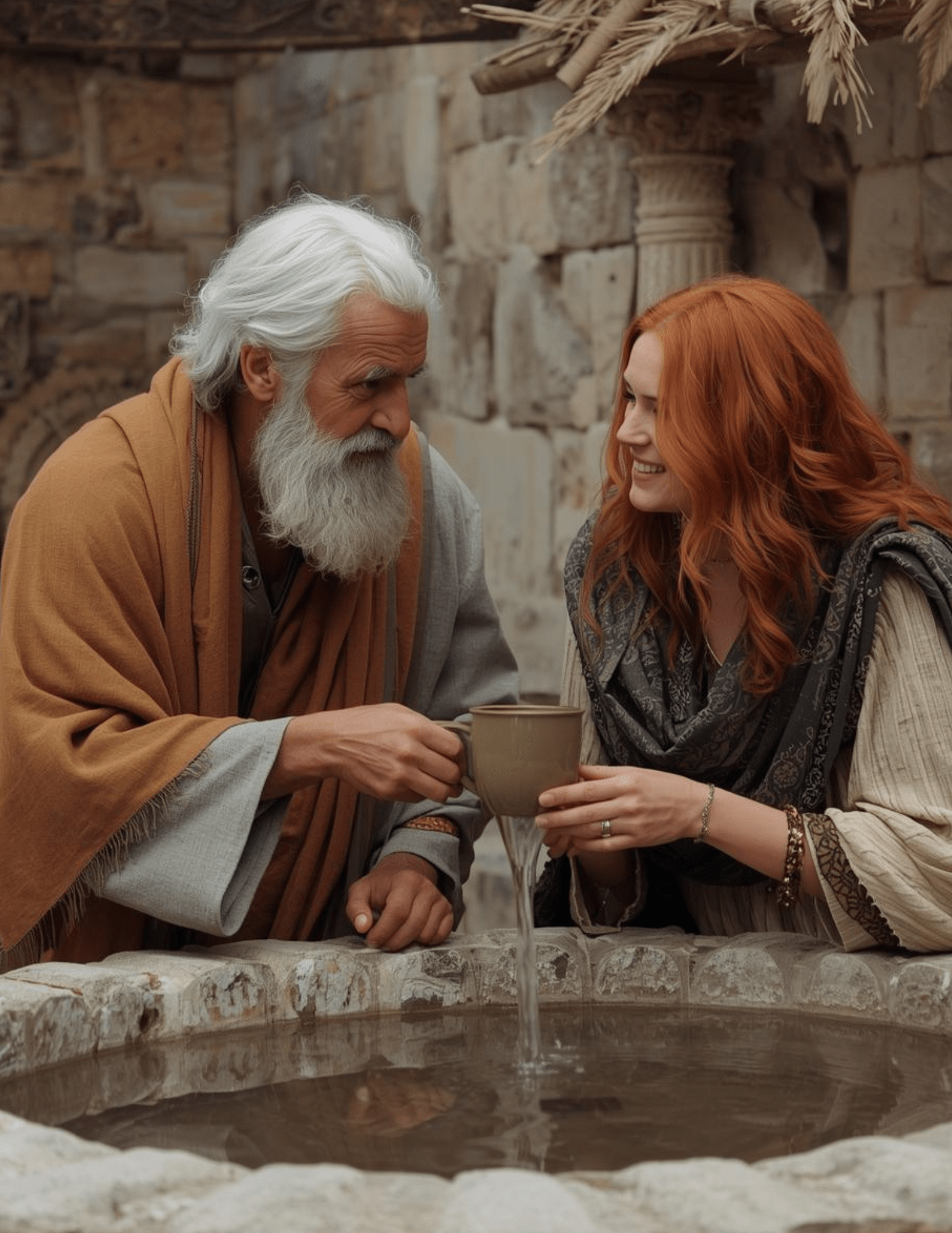
News travels through the grapevine that Jesus was baptizing and winning more disciples than John, the Teacher of Israel identified as the Forerunner.
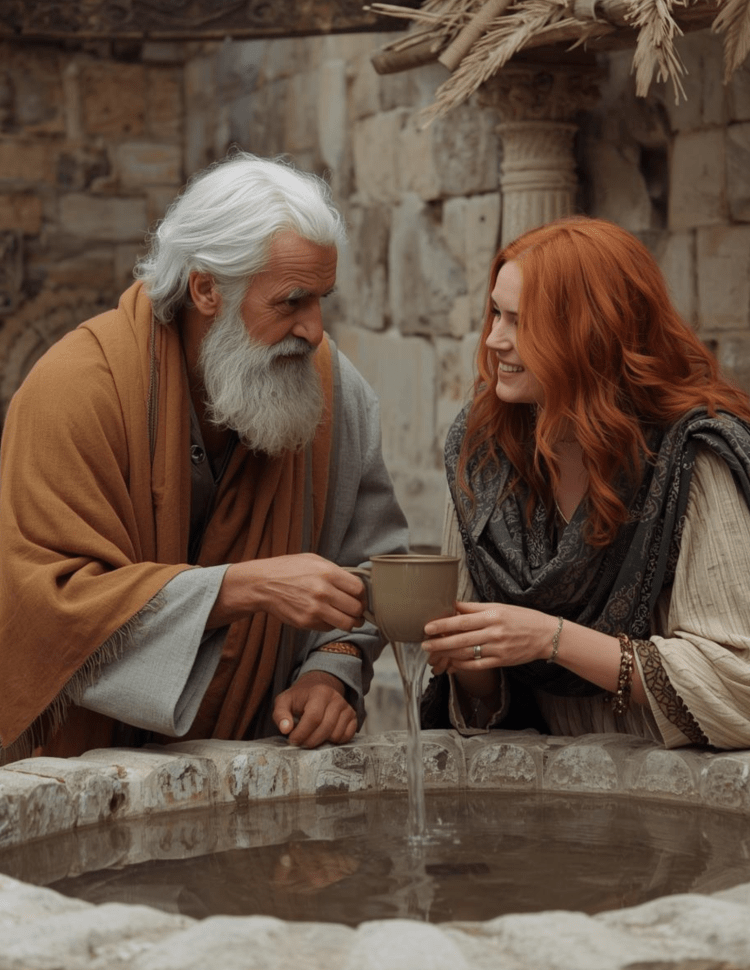
At the well given to Jacob’s son Joseph, a woman identified as a Samaritan appears. Joseph is remembered not only for his God-given prophetic gift, but also for his husbandry.
Yet some will argue that this oral tradition — what some call the grapevine — is not a reliable source. The fruit and juice it produces is the proof. Yet oral testimonies spread from mouth to mouth have a tendency to spread misinformation mixed with facts.
Yet a wine maker or bread maker will testify that the yeast is what causes the bread to rise and the fruit to ferment and make the best wine.
After the two teachers conversed under the cover of darkness, the Teacher of Israel, called John by his disciples, was approached —
(before he was put in prison): A dispute arose between John’s disciples and a certain Jew over the Issue of ceremonial washing…
So John’s disciples came to him and said “Look, Rabbi, the One who was with you beyond the Jordan, the One you testified about — He is baptizing, and everyone is going to Him.” …
So the Rabbi, the Teacher of Israel replied:
You yourselves can testify that I said, ‘I am not the Christ, but am sent ahead of Him.’
The bride belongs to the bridegroom. The friend of the bridegroom stands and listens for him, and is overjoyed to hear the bridegroom’s voice. That joy is mine, and it is now complete…
What confuses the people in the dark is that this man is the Teacher of Israel and speaks with the voice of Isaiah saying:
I am a voice of one calling in the wilderness, ‘Make straight the way for the Lord.’
and when they ask him if he is the Prophet he says:
I am not the Prophet.
What confuses those in the dark will come clear when they realize this teacher — who is clearly the forerunner and the friend of the bridegroom. — is Jesus the forerunner (Hebrew 6:19-20) who heard the bridegroom’s voice when he spoke with Nathanael:
Who asked in (John 1:47):
How do you know me?
And Jesus replied:
I saw you under the fig tree before Phillip called you.
In that same chapter of John, Simon is identified as the Son of John, while other translations say the son of Jonah.
Yet it is Simon who is given the designation of the Rock —which carries with it the responsibility of the Rock of ages — and the Father, Adam saw or heard when he hid himself under the Fig Tree.
Now you may recall in Epiphany VIII: The Anointing:
When the Woman with unbound hair enters — carrying an expensive alabaster jar — Simon thinks to himself:
If this man were truly a prophet, he would acknowledge who is touching him — and how he himself knows of her sin.
The Teacher observes Simon sitting aside, withholding his welcome. He turns toward Simon, and the two enter into conversation. The Teacher tells a parable — of two debtors, one owing much, the other little — and asks Simon which will love more when the debut is forgiven.
Simon answers:
the one forgiven more.
The Teacher says to him:
You have judged correctly.
With these words, the Teacher confirms Simon’s role as Father of the Law and as Nathan, the prophet, a true Israelite beneath the fig tree of memory — who once judged David. For David had abused his power when he took Bathsheba, the wife of another man, and sent her husband into battle where he lost his life.
The fourth chapter of John’s Gospel brings two people out of darkness to talk under the Noon sky where there is no shadow. Here the Light becomes known as Photini — the name given by the Greeks to the Woman appearing at the Well, who is asked for a drink by a prominent Jew.
The name Photini means enlightened one and or luminous one. Scripture situates the Well in the land of the Samaritans at Jacob’s well, bequeathed to Joseph. Thus this woman was identified as Mary Magdalene up until 1970 possibly because in Latin the phrase Sum Maria means, I AM Maria.
As this well known story unfolds, Jesus is identified as being a Jew — not an Israelite.
Whereas when Nathanael asked Jesus:
how do you know me?
Jesus said:
you are a true Israelite and there is no deceit in you.
And then Nathanael replied:
You are Christ the Son of God the King of Israel.
Note. Nathanael does not say “King of Kings.”
So without knowing the meaning of the Hebrew name Nathanael, it is easy to assume Nathanael is just someone who was waiting for the messiah to appear — and see him only as one of the first to believe in Jesus as Christ the Son of God the Father.
However the name of Nathanael as does the name of Simon carries with it something more profound. For the name Nathanael means the gift of God.
Thus pay attention: when Jesus the son of God the Father says, “I met you under the Fig Tree.” This carries with it the idea that Jesus is the born-again Adam — the New Adam — the only Son from the Father, full of grace and truth.
As confusing as this all becomes, Jesus the Forerunner does make the way straight for the Lord for those paying attention. For Jesus the Forerunner is also know as Rabbi John. And the name John means full of grace.
And John does say:
You yourself can testify that I said I am not the Christ, but am sent ahead of Him. ‘For the Bride belongs to the Bridegroom. The friend of the bridegroom stands and listens for him, and is overjoyed to hear the bridegroom’s voice. That joy is mine and is now complete.’
So when did the Forerunner hear the Bridegroom’s voice?
For those paying attention — It was under the Fig Tree when Jesus the Son of the Father spoke with a man given the name Nathanael by those overhearing the conversation. So the Woman known to the Latins as Sum Maria begins to proclaim:
Come, see a man who told me everything I ever did. Could this be the Christ?
And with that proclamation, is she also asking:
Is there a husbandman that I do not yet know, waiting for me?
For the man who asked her for a drink had said:
If you knew the gift of God — AND who it is asking you for a drink, you would have asked Him and he would have given you the water that would spring up in you and make you and everlasting spring.
And Jeremiah once said:
For My people have committed two evils: They have forsaken Me, the fountain of living water, and they have dug their own cisterns—broken cisterns that cannot hold water.
For the Fifth Commandment entrusted to the Teacher of Israel says:
Honour your father and mother, so that your days may be long in the land that the LORD your God is giving you.
Whereas yeast is necessary for the kingdom to spread and rise, yeast can also lead to the demise of the Pharisees who sin under the cover of darkness.
They hide the truth in plain sight while speaking in parables and giving evasive answers.
And they toss in words and names that only a select few will puzzle over and search for the meaning.
_______________________________
This is the eleventh in a series of Epiphany reflections paving the way for the Cross.
Now in Lent, the next Lenten Epiphany turns to the healing of a paralytic — a cripple — at the pool of Bethesda.
If you would like to receive the next reflection, be sure to subscribe.
Discover more from Linda Vogt Turner
Subscribe to get the latest posts sent to your email.
 Linda Vogt Turner