Larry, you say “Jesus did not condemn the Woman for her past life of Sin because Jesus knew She was demon possessed, so therefore She was not guilty of sin by reason of demonic possession.” https://www.wake-up.org/bible-characters/mary-magdalene-mystery.html#comment-2819
Larry makes a good argument and I know many people could easily agree. Although, it is also possible Nicodemus is Jesus the “Good Teacher” who met with Jesus the Woman under the cover of darkness and is therefore the Man caught in adultery with her, Jesus the Woman.
The insanity defence or the demon possession defence robs the Woman of her own moral agency. Mark 16:9 says, “Now when Jesus was risen early the first day of the week, he appeared first to Mary Magdalene, out of whom he had cast seven devils.” Scripture does not name these seven followers of Simon, to whom Jesus said…get behind me Satan (Matthew 16:23).
The chief priests and Pharisees ask the temple guards why they had not brought Jesus in. The guards reply. “No one ever spoke the way this [person] does. ” The Pharisees retort. “You mean [this person] has deceived you also? Has any of the rulers or of the Pharisees believed in [this person]? No! But this mob that knows nothing of the law–there is a curse on them”
Nicodemus, who had gone to Jesus earlier, and who was one of their number, asked. “Does our law condemn anyone without first hearing [the accused] to find out what [s/he] is doing? …Then each went to his own home. But Jesus went to the Mount of Olives. At dawn [Nicodemus] appeared again in the temple courts, where all the people gathered around him, and he sat down to teach them. The teachers of the law and the Pharisees brought in a woman caught in adultery.
At the conclusion of the trial, Jesus the Woman speaks to the Man caught with her which implicitly includes Jesus known to the chief priests and Pharisees as Nicodemus, and everyone who is cast out when Nicodemus says, whoever is without sin, cast the first stone. She does not condemn him nor he her. Both Jesus say, “Go and leave your life of sin.” For as Paul declares to the Romans in 3:23, all have sinned …and are justified freely by God’s Grace through the redemption that is in Christ Jesus.
The insanity defence or the demon possession defence robs the Woman of her own moral agency. Mark 16:9 says, “Now when Jesus was risen early the first day of the week, he appeared first to Mary Magdalene, out of whom he had cast seven devils.” Scripture does not name these seven followers of Simon, to whom Jesus said…get behind me Satan (Matthew 16:23).
Knowing the Law and who Jesus is makes it easier to see these seven devils as the teachers of the law and the Pharisees backing Jesus the Good Teacher known to them as Nicodemus, who brought the Woman Caught in Adultery in for questioning. When the teachers and the Pharisees realized they too were sinners and could not cast the first stone, they were cast out, one by one (John 8:9).
Left alone, Jesus (the Teacher and the Woman) were left facing an exceedingly bitter moral dilemma. How could they work together to reconcile and bring peace and unity to their faith communities now that they had been caught in adultery and outed?
The day of the Blood Moon, I was studying the scripture passage of Saul’s conversion. I had no idea at all that there was to be a Blood Moon that day or any other day this year. I was just puzzled about the Light that blinded Saul and the significance of “Straight” street. Straight street was where the disciples took Saul and where filled with the Holy Spirit, fish scales fell from Saul’s eyes as Ananias laid his hands on Saul.
To understand a bit more about the context of my puzzlement, I should explain. In my last semester as a “Bachelor” an undergraduate student at Simon Fraser University, I wrote an anthropology paper on Paul defending the premise that society has forgotten Paul was a female asserting herself as a scholar, a learned father of the faith.
Last summer, I received a Doctorate for writing The Ecumenical Affair, a creative non-fiction account of a mountain top experience that sent me to university, inspired me to write the aforementioned undergraduate paper, and filled me with an abiding love for God and God’s Ecumenical Household.
In university, I learned how to write essays and how to write creatively so that a writer could choose to put all her eggs in one basket and tell a story that is packed full of wisdom and insight. Some of her characters may have fictitious names and others may not. I have since learned that creative non-fiction or memoirs can threaten “orthodox” perceptions about “what is truth.”
So, I approached the Conversion account of Saul in Acts chapter 9 as a work of creative non-fiction and looked carefully at the names of the characters. The account concludes with Ananias placing his hands on Saul after Ananias himself hears the Lord speak to him in a vision, as a prophet would. Now, as many people of faith acknowledge, prophets create visions using word pictures full of symbolic language such as the sun turned black and the moon turned blood-red.
Many churchgoers may not realize that the name Saul or Solly can be a last name. In fact, my step father’s name was Solly. However, the name Saul in the Old Testament is believed to be the first name of the first king of Israel, before King David. Christians pronounce the name Saul as SOL. So, it is easy for me to imagine myself, as a learned scholar, as Saul a BRIGHT LIGHT sallying forth, letting her light shine like Sol, the Roman God, like Sol the Germanic Goddess of the sun and like Apollo the Greek Sun God http://romanpagan.blogspot.ca/2015/12/prayer-to-sol-apollo.html
In the Conversion Account, Ms. Saul was very definitely asserting herself. Scripture says her letters were threatening the disciples with murder. Thinking back to that paper I wrote as a bachelor, an undergraduate student, I recalled that I had argued that when Saul ended her marriage with her husband Steven, she killed herself as Steven. She broke the legal bond of marriage that made her one with her husband Steven.
Thinking about the stones thrown at Steven the first deacon[ess] of the Church? I asked myself, “Were they actual stones? Or were they living breathing stones connected to a living breathing wall? In I Peter 2:5, Peter the Apostle writes:
And you are living stones that God is building into his spiritual temple. What’s more, you are his holy priests.
Thinking more deeply about Saul’s conversion and the blinding light that caused Saul to fall to the ground, I recalled a more recent memory. I remembered how I looked up at the face of the person I now love deeply and intimately. He was standing behind me, but I could not see him because of all the sunshine streaming all around him and me. He is black. Against all the light his face disappeared. It wasn’t until he spoke and laid his hand on my shoulder, did I realize he was there.
Knowing the names of the Roman and Greek Gods of the Sun is culturally important to the integrity of the story. Knowing the Gospel Easter Story is also important. When Jesus stands in front of Pilate the man who asks “What is Truth?,” the narrative and dialogue reveal three people called Jesus: Jesus Barabbas, Jesus the Christ, and Jesus the Nazarene, the King of the Jews, (Matthew 27: 11-16; John 19:19). At the conclusion of the Acts 9 account of Saul’s conversion, Saul proves to people that Jesus is the Christ (Acts 9:22). Later in Acts 18:18, Apollo also proves Jesus is the Christ.
Another important scripture verse to remember is Acts 4:11 quoted by Simon Bar Jonah also known as Peter.
This is the stone which was set at nought of you builders, which is become the head of the corner.
Beware. The Light can blind and confuse people into discounting Simon as merely a fisher of the great catch, one who is not the one people call Jesus of Nazareth equal in every way to Jesus the Christ, who appeared to the Teacher’s beloved Lady and to the tearful Mary in the garden of the tombs whom he also loved (John 11:5)
Now Jesus loved Martha and her sister and Lazarus.
Remember Simon carried the Cross of Jesus (Mark 15:21).
A certain man from Cyrene, Simon, the father of Alexander and Rufus, was passing by on his way in from the country, and they forced him to carry the cross.
Many teachers insist there were many Simons and these Simons were all different. Call me foolish and irrational, but I simply do not believe that. The Simon carrying the Cross is a Cyrenaic. A Cyrenaic was a philosopher holding the worldly view that the pursuit of happiness is a noble pursuit. Remember Gospel writers also say Jesus renamed Simon, Peter, the Rock of the Church in Matthew 16:17 and then in verse 23 told Peter.
Get behind Me, Satan! You are a stumbling block to Me; for you are not setting your mind on God’s interests, but man’s.
Thinking Peter to be Jesus of Nazareth who was crucified and who prophets say is an eternal high priest, sinless in God’s eyes, not man’s (Hebrew 4:14), I thought it prudent to look up the NAME ANANIAS because Ananias appears in scripture as the high priest (Acts 23:2).
…you will receive power when the Holy Spirit comes upon you, and you will be My witnesses in Jerusalem, and in all Judea and Samaria, and to the ends of the earth.” After He had said this, they watched as He was taken up, and a cloud hid Him from their sight.
They were looking intently up into the sky as He was going, when suddenly two men dressed in white stood beside them.
Men of Galilee,” they said, “why do you stand here looking into the sky?
This same Jesus, who has been taken from you into heaven, will come back in the same way you have seen Him go into heaven.”
When Saul later known as Paul stood trial in Rome, Paul’s vision became even clearer to me. Paul was using prophetic language and trying to bring people “face to face” with the living God who had created and is creating people in God’s own image and “eternal” likeness as living stones, the very heart and soul of the earth. Paul says,
I saw and heard the Lord speak to me in a vision from heaven. He told me “to open their eyes and turn them from darkness to light, and from the power of Satan to God, so that they may receive forgiveness of sins and a place among those who are sanctified by faith in me.
The power of Satan is keeping believers and Paul in chains, because Satan’s power comes from silence, disbelief and spiritual blindness.
Saul called Ananias a white washed wall. (Acts 23:3) Now of course, to call the Lord, the high priest of Heaven a white washed wall sounds like a slap in the face. In some contexts, it is and in others it is a wakeup call.
Remember Jesus calls Simon, Peter and Satan. I think calling the Rock, Satan would be a slap in the face too. Such a negative label stinks and is as insulting as the one Simon the Pharisee and the Prophetic Teacher gave the Woman who anointed Jesus. Both men gave her the label “sinner” (Luke 7: 35-50; Mark 10:17).
So, what am I saying? Was Paul crazy? Was Paul merely retaliating? Or was Paul reminding Peter and those in ear shot that there are three persons proclaiming the Good News of the Resurrection in the name of Jesus who share the role of Christ and all three persons have sinned and fallen short according to the Law of Moses and all three are sanctified, restored and washed clean by their faith in each other and by the forgiveness and faith of their beloved communities.
After Saul’s conversion, Saul sallies forth with restored vision and proves Jesus is the Christ and proves Jesus alive (Acts 9:22). Now…look at other scriptures such as 1 Cor 1:11-13 and Acts 18:28. The Truth is there for people to see with their very own eyes. The Cloud hides Jesus and the Cloud can also make Jesus visible again.
WOW! And the second coming is coming again in these times too. Especially now, when so many people are so sure Jesus is a single divine male who is androgynous.
Have those people forgotten the importance of the Great Commission Matthew 28: 19-20? Jesus commanded the disciples to go forth and make disciples of all nations, baptizing them in the NAME[S] of the Father, the Son and the Holy Spirit? Have people let patriarchal language, monotheism, sexism, racism, political correctness and historical critical thinking cloud their teaching?
I believe Christianity has a gift to share with Humanity, God’s only born child. Other religions can help Christianity and share in the joy of worshipping God by acknowledging the Second Coming is the fulfillment of prophecy. The Second Coming proves Jesus is the fulfillment of prophecy and assures those who believe that they too can come back to life again and again.
Will the Second Coming spell a nuclear disaster? It could. Doomsday prophets and people full of Scripture lessons touting Satan as the Snake and the source of all lies are giving Satan the power to deceive and frighten people with the apocalypse, a sudden destruction of a bigger rock that we know and love as the EARTH.
Take heart. Remember the Rock Jesus called Satan is a stumbling block and the chief cornerstone of the Church’s foundation.
Many churches today filled with priests and church goers may have forgotten or simply dismissed the man called Simon the Cyrene as merely a man who Mark says was “forced” or compelled (out of a deep abiding love) to embrace the Cross of Jesus. As previously mentioned, many teachers of the faith, tell their students that there were nine Simons in the New Testament and only one Peter. https://www.peterdehaan.com/the-bible/9-guys-in-the-bible-named-simon/
This is a big clue.
A certain man from Cyrene, Simon, the father of Alexander and Rufus, was passing by on his way in from the country, and they forced him to carry the cross.
You see, the nine Simons are all one and the same person people have described differently. These nine ways of describing Simon, also known as Peter make the one sure foundation that the Church is built upon.
People need to clue in and help others clue in. What the world needs now is LOVE. People need to know, God created and is creating humanity in God’s own image and eternal likeness male and female. No one person has seen God, for God is love. When we love one another and our neighbour as ourselves we make God visible. When we call people names such as hypocrite, racist, white supremist, slut, lech, homo or homophobe, perhaps we should stop ourselves and ask ourselves. What is going on? What are we doing? Are we loving one another as we see Jesus loving? If so, then perhaps we need to recalculate and rethink what we think we know about who Jesus is.
Jesus came to remind the world that God forgives those who make mistakes and say and do things that are hurtful. Scripture reveals Jesus calling the Pharisees white washed tombs and hypocrites. (Matthew 23:27). Jesus also called the Rock, the very foundation of the Church Satan. What’s going on? Why is Jesus hurling such vicious epithets at people? Where is the love for friends here?
Is Ananias a white washed wall after all? Is Paul merely trying to get his attention, to remind him who he is and his divine calling?
Is this why the Roman Procurator says Saul is insane and why the Gospel of John claims nothing good could come from a town like Nazareth or the region of Galilee? Down through the centuries, worshippers and church doctrine claim Jesus is sinless and yet Scripture passages show Jesus as a hot head telling people off or stonewalling them.
However, the point is Jesus came to show people how to forgive one another and to show how hurtling insults at one another destroys the credibility of the Church and her unified foundation. Today more so than ever before, church goers can clue in to who who Jesus is and the importance of “forgiveness” without spending years in a convent or monastic cell studying Latin and Greek.
Church goers can easily understand literary themes. They can see how Jesus the Rock is not a sinless person full of loving thoughts, twenty-four seven. Nor is Jesus the Good Teacher or the innocent lamb Jesus who entertained the Good Teacher under the cover of darkness.
Patriarchal language is deceptive, even if one knows ancient Greek. So epic movies and other modern forms of media still have the power to deceive. Jesus the Good Teacher visited Jesus the Woman in her home under the cover of Darkness (John 3:1-21; John 7: 50 -52; John 19:39). Yet, Jesus the Woman entertaining the Good Teacher in her home under the cover of darkness is not the innocent lamb or scarlet cloaked demon possessed penitent, tradition makes her out to be. She is aware of the darkness and the intimate setting. The Teacher did not force himself on her. She willingly entertained him under the cover of darkness as if to seduce him into the light. After a lengthy intimate theological chat, she says:
But whoever lives by the truth comes into the light, so that it may be seen plainly that what they have done has been done in the sight of God.
The Atonement theory makes Jesus and all humanity spotless and without sin, by divine forgiveness, or in the words of popular evangelism, washed in the blood of the lamb.
Many modern people believe the “blood of the lamb” atonement theory is outdated. However, they may be more about getting the wolf to admit he has wronged the lamb than they are about getting both the wolf and the lamb to live in peace and harmony as God intended.
In my view, when people truly forgive one another and hold no resentment toward the other for past insults or hurts, they free themselves from a prison full of recrimination. They let go of justifications such as I am the innocent lamb, the victim and you are the wolf, the perpetrator, you must pay for what you have done and you must repent. You must stop being an aggressive wolf and you must live out your days in a zoo or wildlife preserve where zoo keepers feed you kibble. This justification merely, gives the one who feels wronged the power to persecute, victimize and oppress the one who has done him or her wrong.
In the new heaven and new earth prophecy, the wolf and the lamb will lay down together. The lion will eat straw like the ox! (Isaiah 65:25) In other words, the lion and the ox will both eat humble pie. Both will have to take responsibility for their own part in the drama caused by their conflicting needs, wants and desires or those of their communities.
According to prophetic wisdom, the Day of the Blood Moon, signals the end of time. People have seen many blood moons and the end of time has never arrived. So why should this time be any different? Things have heated up in the world and people are extremely divided on issues. Nuclear energy and nuclear weapons makes the destruction of the earth more likely now than ever before.
It is very possible his old earth will renew with what some may call a nuclear explosion caused by the rapid release of energy from a nuclear reactor. It is also very likely many Christians and non-Christians will fear this day as the “terrible Day of the Lord” (Joel 2:31) and step up their efforts to save the earth through conservation and ascetic efforts that see indulgence and luxury as sins or crimes against nature. Many liberal Christians may agree with them and many may not and many others may try to discredit them, in their zeal to honour more modern worldly thinking.
However, I believe it is more likely people of faith will rally together realizing Conservative and Liberal Christians and nations have much to learn from each other. Rallied together, forgetting old animosities, Liberal and Conservative Christians will welcome the Day of the Lord and live to tell their grandchildren and their neighbours they saw this old earth have a conversion experience like Saul’s when the sun turned black and Artemis, the sister of Apollo, the Greek goddess of the moon became cloaked in scarlet as Saul alive and well after many perilous journeys, carried the name of the Lord before the Gentiles, their kings and the people of Israel (Acts 9:15).
Poor Rudolf the other reindeers laughed and called her names like he and maybe even Dorcas or Dork for short. Then one foggy night Santa, being all tarnished with soot came to say…Rudolf…with your nose so bright…will you guide my sleigh tonight?
The Christmas tales told to children allow some adults to glean bits of divine truth that reveal how the gifts of Hope, Peace, Joy and Love come into the world.
All is quiet not a creature is stirring…no one is speaking up. I wonder why? Why does Santa come down the chimney? Why does he come down from heaven…from the night sky through such a narrow opening? Why does old Saint Nick come under the cover of darkness? Why is “he” wearing a scarlet suit?
Two Scriptures that may shine like a bright red clue for you are:
Many kids have heard, if they’re naughty they’ll get the gift of coal and if they’re nice they’ll get Candy…hard rock candy shaped like a shepherd’s crook. People from Crete may get that one. Did you know that Crete was once called “Candy” by Brits? And did you know Cretans were one of the first Christians to welcome the Holy Spirit and her tongues of fire? (Acts 2: 1-12) http://sundayteacher.com/vcmedia/2414/2414925.pdf
But why coal? Why would Old Nico, Mr. Noddy, give naughty kids a block of coal in their stockings? Why would naughty kids who run around the city stealing to keep warm, need a lump of coal?
Did you know that there was a Father called Simon who carried the Cross of Jesus? Mark 15:21 Many Christians believed he was black because he was called the Cyrene. Cyrene was a city in Northern Africa. In addition, Cyrenaics were sensual hedonists. So, today many simply say there is no proof that Simon was black or a hedonist. And some even ask. What difference would it make anyway?
Well if Simon is the Black Rock that was rejected, what does that make Simon? Sshh…not a creature was stirring not even a wee biddy didymous.
Did you know that Dorcas is the Greek translation of the Aramaic name Tabitha meaning “gazelle”? A Dorcas gazelle is also known as an ariel gazelle, a little deer with horns and a reddish brown, a rufus coloured coat. (The Latin word rufus means red haired one)…mmm Disney’s Ariel the little mermaid has red hair too!
Did you know that Simon (who Jesus called Peter and Satan) raised Dorcas from the dead? You can read about this in Acts 9:36-42; John 1:42 and Matthew 16:23).
As you can see, much can be gleaned from thinking about Old St. Nick letting Rudolf the Red Nosed Reindeer lead the way, one Foggy Christmas Eve.
Do you remember the TV show “Touched by an Angel”? I watched it this past Sunday. God had called angels Tess and Monica and Adam to help three people trapped in adultery to face the truth in time for Thanksgiving dinner.
“Monica and Tess arrange an accident on a deserted road for Megan and Susana, two women involved with the same man. The angels create an estate where the women and eventually Susana’s husband spend Thanksgiving together. The angels are assisted by Adam, who doesn’t have the heart to kill the turkey for dinner. Monica convinces Megan that she must find someone else and Tess convinces Jack to return to his marriage.”
In the TV Show “Touched by an Angel, guess what the Turkey’s name is, that Adam does not have the heart to kill for dinner? It’s not “Drumstick or Wishbone? It’s Alexander.
TAKE NOTE!! Touched by an Angel is a TV show about ANGELS who cannot die…and who preach the message of the Cross, that is a stumbling block to Jews and foolishness for Gentiles (1 Corinthians 1:23).
ALEXANDER…according to Smith’s Bible Dictionary is a man of mischief who (according to Paul) caused a great shipwreck concerning the faith.
Alexander and Hymenaeus, the God of Marriage, were (and still are) causing trouble for Paul’s evangelical crew and mission. In addition, gnostic teaching was insisting that the resurrection of Jesus was a spiritual one, and not a bodily one. So, Paul handed Alexander and Hymenaeus over to Satan (aka Simon aka Peter (Matthew 16:23) to learn not to blaspheme, because according to Paul no one should be a stumbling block for his/her brother/sister. All should live according to the Law of Love (Romans 14:12-13).
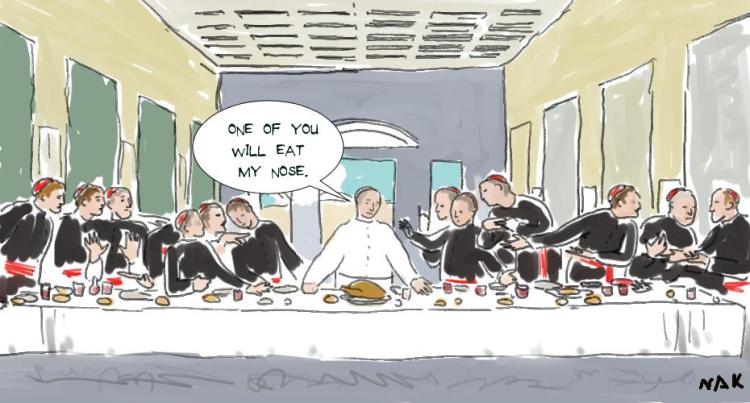
It is important to know who Alexander is and why turkeys are important for Canadians and Americans at Thanksgiving and Christmas. When I was growing up, we were taught the Turkey’s name was Tom…and the empty cavity stuffed with bread had something to do with Jesus and the Pope’s nose was the tail.
Happy Thanksgiving to all my American friends and neighbours, may you have a feast day full of Love!
Smith’s Bible Dictionary
Alexander
Son of Simon the Cyrenian, who was compelled to bear the cross for our Lord. (Mark 15:21)
One of the kindred of Annas the high priest. (Acts 4:6)
A Jew at Ephesus whom his countrymen put forward during the tumult raised by Demetrius the silversmith, (Acts 19:33) to plead their cause with the mob.
An Ephesian Christian reprobated by St. Paul in (1 Timothy 1:20) as having, together with one Hymenaeus, put from him faith and a good conscience, and so made shipwreck concerning the faith. This may be the same with
Alexander the coppersmith, mentioned by the same apostle, (2 Timothy 4:14) as having done him many mischiefs.
The title of Sunday’s sermon at St Andrew’s Wesley United Church in Vancouver, was The “G” Word. The Rev. Dr. Gary Paterson chose the title as a stewardship title to encourage people to give generously to the Church in the coming year. The main Gospel text he chose was the Zacchaeus Story found in Luke’s Gospel chapter 19: 1-10.
Last Wednesday evening at a theology for non-theologians held at St. Andrew’s Wesley, the Rev. Dr. Richard Topping the Principal of Vancouver School of Theology also used the Zacchaeus Story. He used it to illustrate how Jesus as feminists and inclusive churches do today, advocate for and associate with lepers and socially marginal outcasts.
So I went home last Wednesday night, thinking about Zacchaeus. I was surprised on Sunday morning to find that Dr. Paterson had been reflecting on the Zacchaeus story too, because it was not the lectionary reading for this week.
In Luke’s Gospel, Zacchaeus is a little person who is judged a sinner by those who gossip!
Christians then as today, prejudge this little person according to patriarchal language, sexist attitudes, and the gossip present in the text. They are sure Zacchaeus is an unclean person, a sinner who needs to “turn” and repent. Yet, the name Zacchaeus is a Hebrew name meaning “clean, pure.” This little person encountered Jesus in Jericho* and agreed to house him over night.
People assume this little person is male. However, my experience leads me to believe, this person was female. Even though this rich “little” person may have collected rents and taxes as a property owner, she may not have cheated anyone except herself and her own family. People assume, because she collected taxes and she was rich and was only willing to give half of her wealth to the poor, she was “cheating” and exploiting the poor, unjustly. Peter and the other disciples had sold all their property for the sake of the Kingdom (Luke 18:28-29) and this little person had clearly not.
Two Sundays ago, on Sunday October 1, 2017, the Gospel reading Matthew 20:1-16 was paired with Exodus 16:3-18 to celebrate World Wide Communion Sunday. I was the reader.
In the Exodus passage, the Israelites said to Moses, “If only we had died by the hand of the Lord in the land of Egypt, when we sat by the fleshpots and ate our fill of bread; for you have brought us out into this wilderness to kill this whole assembly with hunger. Then the Lord said to Moses, “I am going to rain bread from heaven for you, …and in the morning there was a layer of dew around the camp…there on the surface of the wilderness was a fine flaky substance, as fine as frost on the ground.
This food that came down at the prayerful request of the Lord… looked like “hoar frost” and it saved their lives.
The second reading came from Matthew 20: 1-16. I read the New Revised Standard Version with a few edits to make a point.
For centuries, people have assumed the Sinner Woman of Luke 7 is a whore because Simon and Jesus the “Good Teacher” say she is a sinner who has been forgiven because she “loves much”. In addition, tradition links her with a woman called Mary sitting at the feet of Jesus who worried Martha, the good housewife and homeowner of Luke’s Gospel. When Martha complained to her Lord and asked that he command Mary to “help” her, her Lord then told Martha that Mary had chosen a better part and it would not be taken from her (Luke 10:38-42).
With communion and those passages in mind, I dressed myself in a white dress, tan coloured heals, matching purse and shawl, and a tawny, chrysanthemum pearl necklace trimmed in sliver. Then at the appropriate time in the service, I came forward and read both the Hebrew and Gospel passages.
I read the parable of the Labourers in the Vineyard as told by Matthew, the tax collector, with a few minor edits. I changed the male gender throughout the passage to the female gender and included three little extra words. I told Dr. Paterson when we did the sound check, that I had changed the gender in the text. So he was somewhat prepared. However when read aloud, the passage read with the feminine gender may have offended and shocked a few people.
Here’s the complete passage as I read it.
‘For the kingdom of heaven is like a landowner who went out early in the morning to hire labourers for [her] vineyard. After agreeing with the labourers for the usual daily wage, [she] sent them into [her] vineyard. When [she] went out about nine o’clock, [she] saw others standing idle in the marketplace; and [she] said to them, “You also go into the vineyard, and I will pay you whatever is right.” So they went. When [she] went out again about noon and about three o’clock, [she] did the same. And about five o’clock [she] went out and found others standing around; and [she] said to them, “Why are you standing here idle all day?” They said to [her,] “Because no one has hired us.” [She] said to them, “You also go into the vineyard.” When evening came, the owner of the vineyard said to [her] manager, “Call the labourers and give them their pay, beginning with the last and then going to the first.” When those hired about five o’clock came, each of them received the usual daily wage. Now when the first came, they thought they would receive more; but each of them also received the usual daily wage. And when they received it, they grumbled against the landowner, saying, “These last worked only one hour, and you have made them equal to us who have borne the burden of the day and the scorching heat.” But [she] replied to one of them, “Friend, I am doing no wrong; did you not agree with me for the usual daily wage? Take what belongs to you and go; I “choose” to give to this last the same as I give to you. Am I not allowed to do what I choose with what belongs to me? Or are you envious [jealous] because I am generous [love much]? So the last will be first, and the first will be last.
However, I take offence when people assume the clean little rich person of Luke’s Gospel, had somehow acquired her wealth illegitimately, by over taxing and exploiting them. This little person accepted Jesus’ invitation to dine with him and Jesus is the one who admits that this person is a descendant of Abraham that has been lost and is now found. If she is guilty of any wrong doing, so is he.
People may think my theology is offensive and or off the mark and that I am over identifying with Jesus and this little person in Luke’s Gospel. However those who do, would benefit from reading my Master’s thesis project, Mary Magdalene: Her image and relationship to Jesus and my memoir, The Ecumenical Affair for which I earned a doctor of humane arts degree. http://www.lindavogtturner.ca
My name happens to be Linda. In Italian, Linda means “clean” and the family name I had before my husband and I divorced was Vogt. Coincidently, my late father-in-law’s name was Abraham. When I attended the 6th Assembly of the World Council of Churches held out at the University of British Columbia, not far from Jericho Beach, I encountered a certain Greek male renowned for his peace making. I have since learned this Greek has a very close colleague by the name of Luke.
When I attended the 7th Assembly of the World Council of Churches in Australia, a man from Switzerland noticed my name tag. He told me that in his country the name Vogt was a derogatory term people used to call someone they thought was a cheat. Evidently to call someone a vogt was to call someone a dirty tax collector!
If Christians want to dig deeper into the understanding of the Scriptures and who Jesus is, they will find out that the Gospel sycamore tree is a type of fig tree that is easily killed by frost and or hail stones (Psalm 78:47).
Sycamore Tree. Photo by Ferrell Jenkins.Sycamore figs. Photo by Ferrell Jenkins.
Christians may recall from John’s Gospel chapter 19:34, how a military person (a vogt) https://en.wikipedia.org/wiki/Vogt) pierced Jesus’ body as it clung to the Tree, 3 days before it bore fruit and appeared alive in the garden of the tombs.
Today as then, stories enrich our lives and communities. A well told story or memoir embellishes the truth to help people grow in human understanding. The Sycamore Tree, like the Tree upon which Jesus hangs has been used to keep people content with poverty and willing to sacrifice their lives. The death of Jesus of Nazareth and the releasing of Jesus Barabbas (Matthew 27:17) has been described in military terms as if nailing or tying down the confirmed bachelor of Mary’s hometown to a Tree that is like a vine bearing lots of fruit (psalm 128:3) and the releasing of a renowned resistance leader would start a revolution that would end in a horrific apocalypse.
Writers and stain-glass window makers have done a great job of convincing Christians that the Cross and the Crucifixion was a violent and horrific reality. It is almost impossible for modern believers to see the Cross and the Crucifixion story as a love story. It sounds like nonsense. Violent and horrific deaths occur when people go to war or seek to punish, torture, and kill people who the moral voice or majority feel are unworthy. So the belief persists that Jesus accepted death on the Cross as a historical reality in the same way as criminals in ancient Rome were tortured and put to death.
However, in Jewish tradition, when a bachelor gives himself in marriage, he is reborn. To be reborn, he must die to his old life. As a symbol of his readiness for marriage, a bachelor who has taken a Nazarite vow would shave his head. He would look like a skull! (Numbers 6:18). A Nazarite is not even allowed to drink vinegar, or grape juice, let alone real wine, until he has shaved his head and presented 3 peace offerings, a lamb, an ewe, and a ram.
Before Jesus of Nazareth is firmly committed to the Cross, a soldier or a person with a name synonymous with soldier (https://en.wikipedia.org/wiki/Vogt) offers him a hyssop stick that has been soaked in bitter wine. He refuses to drink this bitter wine.
The names of the characters in the Gospels confuse many people and scholars do a diligent job of presenting the characters as if they are many separate characters rather than names and words ascribing characteristics to the principle characters.
It is no wonder devoted Christians all over the world, release Jesus Barabbas from prison and then fail to see him as Jesus the “Good” Teacher also known as Nicodemus who looked at the rich little person and loved her (Mark 10: 17-21) and visited with her the red-headed female Jesus under the cover of darkness (John 3: 1-21; Luke 19: 1-10) and met her again at the Well (John 4) and then face to face in the garden of the tombs (John 10: 11-18) where she realized Jesus the Teacher was not the Gardener and the Father of the Law and Oral Tradition, but the Son (Mark 15:21; John 20: 15-17).
Moreover, it is not surprising that devoted believers without the benefit of speaking several languages then reject Jesus the Nazarene as her Bridegroom, her Stag, the Hart and Cornerstone of the Gospel, the “sweetheart’s” stone, “Jo’s” cephas, who takes her for his wife, the most blessed of all women (Luke 1:42; Matthew 1:20), the Ariel Gazelle, the Bride of Song of Song of Songs and Psalm 45 to fulfill the Hebrew Testament promise (Micah 4:8; Isaiah 62: 3-5); Song of Songs 8:12-14; Acts 4:11; Acts 9: 36-42).
These are the last days and it is time for Christians to realize the little person climbing up and down the Sycamore Tree accepted Jesus’ request to spend the night, to stay, at her house. She did so of her own free will. She even climbed up the Tree to increase her stature, her social standing, so that she could meet him.
Down through the centuries, many people have been sexually abused by people with authority in the Bible and in the Church. The abused may have accepted their advances willingly. But their willingness does not make the authority figure, the Jesus figure, clean and them dirty. Each time Christians insist, the little person of Luke’s Gospel is the dirty one and the visiting Teacher is the clean one, they are keeping salvation from being realized in their house.
*Jericho is the city in which Rahab lived and owned a house. As the story goes, Rahab was a “sinner” woman, a woman who was generous with her hospitality. And so, biblical tradition and righteous people call her a whore, yet James 2:25 claims she was justified by her hospitality.
St. Gabriel the Fool for Christ once said. If you have everything else, but love, you have nothing. St. Gabriel’s thought that “Love dominates all rules and laws” sits a bit heavy of my heart. I think of love being passive and gentle, not dominating. And yet as the psalmist penned in Solomon’s Song…”Love is strong as death; passion fierce as the grave, its flashes are flashes of fire, a raging flame. Many waters cannot quench love…”
In my book The Ecumenical Affair, the Woman self identifies as Mary Magdalene and the Woman of Solomon’s Song. In my Master’s thesis, I examine modern revisionist theories claiming there is no explicit evidence to support the idea that Mary Magdalene was the Sinner Woman of Luke 7 who loved much.
St. Gabriel the Fool for Christ of Samtavro in Georgia
Who shall separate us from the love of Christ? shall tribulation, or distress, or persecution, or famine, or nakedness, or peril, or sword. Epistle of Paul to the Romans: 8, 35
Love dominates all rules and laws. Denounce a man with love. God is an infinite Love, Goodness and Justice. Who loves goodness and justice, he loves God and he is loved by God as his own child.
If you have everything else, but love, you have nothing. If you hate even a single person – you are disgusting before GOD. Love your enemies – it’s clear. But how to love enemies of Christ?Stop hating and then you will be able to love them. How to love the evil man? Hate the evil, but love those who do evil. Who knows maybe one day they will repent their sins…
This past Sunday, the scripture lesson focused on Exodus 3, Moses and the Burning Bush.
As the story goes, Moses encounters a burning bush tending a flock of sheep in the wilderness. Through the encounter, Moses hears God’s voice. God wants Moses to return to Egypt and free the Hebrew people who are slaves of the Egyptians.
In my book The Ecumenical Affair, the Woman is that Burning Bush. She is on fire for women’s liberation. The year is 1983. She is sure Jesus and Mary Magdalene had an illicit affair and that sexism has suppressed this story to support the religious view that sex outside marriage is a carnal sin that Jesus would never have committed. The traditional view presents the Woman Caught in Adultery as someone Jesus refuses to condemn even though he knows she has committed adultery.
In 2011, I successfully defended my Master of Arts Liberal Studies thesis project Mary Magdalene: Her image and relationship to Jesus. I claimed Mary Magdalene was the Woman Caught in Adultery and her co-respondent was Jesus. My thesis held.
My thesis maintains that Jesus the Teacher, the Rabboni of John 20, was married to Martha, the beloved. As scripture says, Jesus the Teacher loved both Martha, the housewife and her sister Mary (John 11:5). Did Mary Magdalene ever marry is another question?
Since writing my thesis, I have brought Jesus the Rock into view. Jesus the Rabboni is clearly married. And this is the Jesus the Woman encounters in the garden of the tombs. Here in the garden, the Woman is weeping (John 20:15). She is not so sure the prophecy has come true. She’s looking for her Lord. Jesus the Rabboni is not the Gardener and he has not taken her Lord’s body…so where should the Woman look for her Lord’s body.
The Weeping Woman is looking for her Lord who is her Rock (Psalm 18:2) and her Gardener, her Husbandman, the Vinedresser (John 10: 30; John 15:1; and Psalm 128: 1-3).
Responding to her tears, Jesus the Rabboni calls her Mary. This is interesting and important because in the book of Ruth, the Widow Naomi returning to her people, says, “do not call me Naomi, call me Mara for the Almighty has treated me exceedingly bitter.”
Is this bitterly treated Woman, the Vine?
In the Exodus story, the voice of God calling from a burning bush in the wilderness sends Moses back to Egypt to liberate the Hebrew slaves from an idolatrous nation that is keeping them in physical and spiritual bondage.
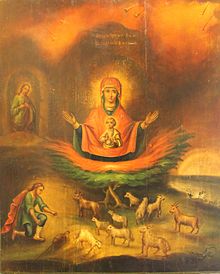
The Icon of the Theotokos “Burning Bush” of the Old Testament. 19th century, Polissya, Ukraine.
When Moses asks the voice who shall he say is sending him? The Voice says, tell the Israelites that “I am has sent me to you.”
In the Gospel of John, Jesus the Rabboni is standing on Holy ground, in a garden adjacent to a burial ground. The Rabboni standing “face to face” to the Woman says, “do not cling to me” as if she were indeed a clinging vine. Then the Rabboni tells her to go to his brethren and say, “I am ascending to my Father and your father, to my God and your God.”
What is the Rabboni saying? Is he going to the Father? Or is she going to the Father. I believe she is going to the Father and she is to tell the Father and the disciples…that she is the I am. She is the I am that is created in God’s image as an eternal person. She is the I am of the flame in the burning bush and the flaming torch that is ascending to take her divine place as the Father and the Son’s equal.
Who is the incarnate Father to whom she ascends? Is he the Rock the builders rejected? I think so. Here’s why.
Who is called the Rock in the Gospels? Think about it. It is Simon! Does Simon take anyone’s hand after the Woman’s encounter with the Risen Rabboni at the tomb? Yes.
In Acts 9: 36-42, Simon takes Dorcas’ hand and lifts her up. Don’t let Simon aka Satan trip you up. Simon Peter has a mother in law who has a fever. This does not mean he is married. It may mean he was married and is either divorced or a widow. Or it may mean, the Woman he is to marry with a new covenant is the Mother of the Law and the Prophets that is now aflame.
As the Rock and Groom of the New Testament, Simon Peter remains unmarried until he lifts up Dorcas as her Lord coming in the name of Jesus of Nazareth. He is the Rock that she is waiting and looking for and the one the builders rejected (Acts 4:11). He is also the Simon that carries the Cross of Jesus…Mark 15:21 the Father of Alexander and the Red Haired One (Rufus), the flame, the torch, the helene.
Don’t let the names and the commas in the different stories confuse you. Take out the commas and read the scriptures again. Commas and verses are a modern editorial thing. The name Dorcas is the Greek translation for the Aramaic name Tabitha which means Gazelle. Dorcas is the Gazelle…that the STAG of Song of Songs revives (SOS 8:14).
In my book “The Ecumenical Affair” the Woman has a conversation with an Orthodox Bishop. They talk about the secrets, the sacraments of the Gospel. The Bishop maintains that keeping these secrets are important because without the sacraments (secrets), new Christians would not be curious enough to participate in seeking their own salvation. The Woman counters, saying she thinks the secrets are keeping the Truth hidden and making it difficult for modern people to believe.
So, dear readers, I appreciate the fact that you have studied the Scriptures and are faithful followers of Jesus. There are books and blogs out there my own included that help Christians see Jesus of Nazareth and Jesus the Rabboni more clearly so that Martha and Mary come into view as their beloved Ladies full of Divine Love and Grace.
Jesus of Nazareth is the Groom, the husbandman, the Gardener of the New Testament. Jesus the Rabboni is not that man. He is the faithful husband of Martha. He did not divorce Martha, his beloved Lady. He loved both Martha and Mary. Mary is the Bride of the New Testament. She wanted something more. She wanted a new way of being a wife…a way that did not make the Woman subservient to the Law and her husband. She turned away from sin and chose the better part. She was able to dry her tears because this better part was not taken away from her.
I look forward to hearing more from you. The World needs mature Christians to rally other Christians together so that Christianity can be a mega helene…a great torch, a Light for all nations and a great body of peacemakers. Peacemakers are gap crossers. They find ways to bridge heaven and earth and make friends with their enemies.
This week’s Scripture Reading came from the Book of Exodus. The Egyptian King was worried about national security. He had allowed more Hebrew people into the country than he and his government could control. Egypt’s enemies were threatening war and the King was afraid the Hebrew people would multiply, rise up and flee the country to side with the enemy. Despite punitive measures, the Hebrew people thrive with the help of two Egyptian midwives and the Pharaoh’s own daughter. As the story goes, the Hebrew people eventually leave Egypt in a mass Exodus. God parts the Red Sea to allow the Hebrew people to escape, the Egyptian soldiers follow, God rolls back the sea and the soldiers all drown.
The Minister at St Andrew’s Wesley, put this story in a modern context. During the worship service and sermon, the Minister mentioned how glad he was as a brand new Canadian to be involved in a such a welcoming church as St Andrew’s Wesley. He told how his family and a small delegation from the church came out to his citizenship ceremony last week.
To fill the congregation in of what happens before and during a citizenship ceremony, he told them a little bit about the process. He said he had to study Canadian history to learn about the political process and culture. Then he had to live here for several years. And finally, he had to pass a test of his Canadian knowledge and a criminal and terrorist background check.
Part of the Worship Service involved a little ceremony to honour the Minister’s new citizenship. In answer to the question. “What do you like best about living in Canada?” The Minister said. “Oh, the usual…the beauty of the scenery, the friendliness of the people.” And then he slipped in something many new Canadians might say. He said. “He was glad to be here because of who was not here.” Ouch!
Many people pride themselves on their Canadian identity by saying “we’re not Americans”. We are not nationalistic like our American friends to the South. We are peacemakers.
Last week the Minister attended and urged others to protest an anti-muslim protest rally. He and many other people want to resist and quell any fear or public sentiment that Muslim refugees pose a threat to Canadians.
A growing number of Christians in Canada are more conservative. They want people to be fully aware of the risk too much rapid immigration and too many refugees poses to the Canadians already here. They also want Canadians to realize how American politics are affecting Canadians. The Democrats lost the election and they are using the media to voice their fear and mistrust of the elected President and his Conservative Government.
Many Canadians are also speaking up and out against President Trump with fear indignation, and hatred. Many are blaming President Trump for the rise in white citizens voicing their resentment or fear of people of colour using their political voice and power to oppress and silence the struggling working class white people.
The Minister at St Andrew’s Wesley created a vivid picture for me on Sunday. The cycle of deifying one’s own political group and demonizing others divides people. It causes people who are the targeted, oppressed group to multiply their numbers and to storm out or flee in anger and frustration.
Peacemakers strive to resolve conflicts through friendly means. Like Jesus, they lift up parables or word mirrors and let people see how they look to themselves and others. Peacemakers resist the temptation to throw stones. They try to promote human understanding and accept people as they are and where they are. Peacemakers encourage people in conflict to work things out in their own hearts through prayer and between themselves through dialogue.
Peace through dialogue is not always possible. In order for dialogue to work, there has to be mutual respect. Mutual respect is not possible if one partner is full of rage and bitter resentment and the other partner fuels that anger by counter protesting with better logic more political strength and more moral or public support.
I think public demonstrations vent frustration and can start a conversation. Other times demonstrations merely win people to one side or the other and promote social unrest. Like a boxing match, the one who gets in the best punches wins.
Last week, I had a fight with my Man. I was angry and hurt at something he did and I could not keep the anger out of my voice when he called. He did what he usually does when I try to explain why I am angry and upset. He hung up. This just makes me even angrier and more frustrated. I wanted to break this cycle. So being a modern gal looking for wisdom, I consulted GOOGLE.
On GOOGLE I found two interesting articles that allowed me to see what my Man and I were doing and why we were having so much trouble talking with one another.
The first article was a Huffington Post Blog What To Do When You Can’t Talk It Out posted by Dr. Margaret Paul. It opened me up to the idea that it is better to learn from the argument than it is to be right and win.
“Be anxious for nothing, but in everything by prayer and supplication, with thanksgiving, let your requests be made known to God; and the peace of God, which surpasses all understanding, will guard your hearts and minds through Christ Jesus.”
I am learning how to be a peacemaker. The more I learn, I realize I have a lot more to learn and I am open to learning from other bloggers and readers. I look forward to hearing from you.
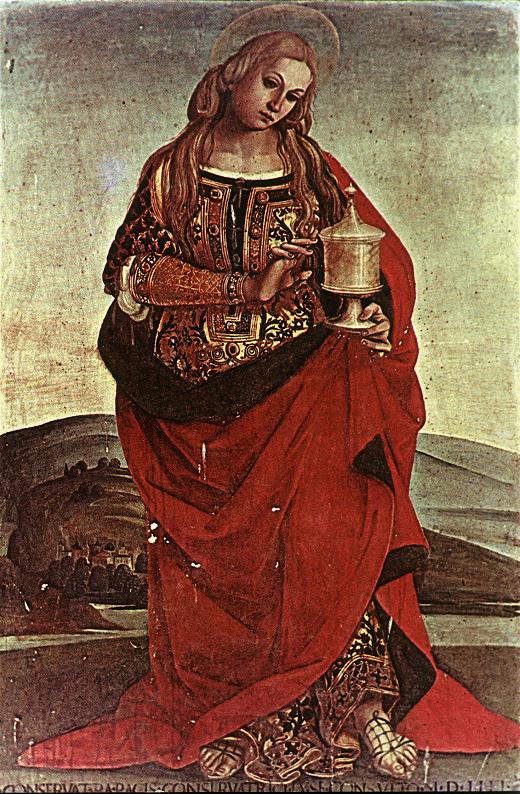
What do you do when people you love ignore your hurt feelings? This is an age old question. In this painting by Luca Signorelli, Mary Magdalene is depicted as a very rich person holding an alabaster jar. Her face tells onlookers her feelings have been hurt.
SIGNORELLI, Luca Mary Magdalene 1504 Panel Museo dell’Opera del Duomo, Orvieto
Recently, a man I love very much hurt my feelings, told me I had no reason to feel hurt, and then when I attempted to explain why I felt the way I did, he hung on me. Hanging up on me, was too much. I felt like he had slammed a door on me and excluded me from his inner sanctum. I want to be intimately emotional with this man and I could clearly see our coping skills were out of sync. So being a modern gal, I went searching for answers via Google.
Thank you http://www.peacefulsinglegirl.wordpress.com Your suggestions were quite helpful. You pointed out that men are wired differently than women and need time to process their thoughts and feelings. They need space and time to think things through.
Thinking back on Mary Magdalene’s sad face, I recall what I wrote about the Magdalene’s feelings in my thesis. There I wrote.
Franco Zeffirelli’s 1973 Jesus of Nazareth not only portrays Mary Magdalene as a forgiven prostitute, it also portrays her as Luke’s sinner forgiven for her great love as the woman who anoints Jesus (Tatum 140). The movie ends with Mary Magdalene going to the disciples who are in hiding. They dismiss her testimony as fantasy. According to the American biblical scholar Jane Schaberg, the angered Magdalene “growls, ‘Was his death a fantasy?…Why should he not appear to me? [Then coldly] He told me to tell you, and I have done so.’ She flings back the door, and slams out.” Peter’s disbelief turns to belief and, according to Schaberg, the “Magdalene’s message about an empty tomb” disappears because Peter takes her message and reduces the significance of the resurrection to forgiveness (Mary Magdalene Understood 65).
I’m starting to understand something, I hadn’t previously considered. People need time and space to forgive. What Mary Magdalene did was very wrong. She let people gossip and think she was a prostitute to protect Jesus the Teacher and his beloved Lady and their community from learning the Truth about her. And then when the truth finally comes out and people learn that he and she spent the night together, people are going to slam the door on her when she goes and tells. They like the man dealing with his thoughts and feelings, feel disrespected and the more she tries to explain, they feel she’s yelling. She should lower her voice and be more discrete and let them figure things out for themselves.
In the aftermath of World War II, Crete was full of hatred and anger. The country had been invaded by the Nazis and the Cretans vowed they would never stop hating the Germans.
In The Ecumenical Affair a young Canadian woman and an older Greek man find themselves alone one hot July night.
“Tell me a story. About you. When you were a little boy.”
He worms out of his jacket. Fishes into his shirt pocket for a cigarette. Cocks his left brow. She offers no resistance. He lights it. Grips it like before. Leans back. Puts his left foot up on his knee. Blows smoke away from her—pushing out his bottom lip. Continues: “When I was the age of the children in those pictures on the piano the Nazis occupied my country. This you know?”
She shakes her head.
“When the parachutes came, villagers armed themselves with kitchen knives and garden scythes and hid in the long grass at the edge of the field. As the paratroopers landed, the villagers attacked as many as they could. The German high command was of course outraged. In retaliation, they ordered the mass slaughter of whole villages: women, old people, children, babies. You’ve seen how they do this in movies?”
She nods.
“Our village wasn’t directly involved with the invasion. But to make sure we wouldn’t fight back, the Germans took the men away in buses—to camps surrounded by high, chain-linked fences and barbed wire—it was bad for the women. They had no one. No one to protect them from the soldiers.”
“Was it bad for you?’
“I survived. I worked in the Resistance. I could talk to the guards. I could speak German. So, I would tell them stories and sneak in Greek words and things; things that those standing nearby could pick up.”…
The Young Woman. Now middle-aged…sits on a gold and green brocade sofa. On her lap is a best-seller she found at the church bookstore. …
She folds back the cover. Fans the pages. Stops. Creases it open–quarter way from the end.
“Are there any questions? This question was asked by a Greek teacher, a philosopher and a legendary peacemaker…after a two-week Socratic symposium on Greek culture.
As participants rose to leave, Fulghum countered. “What is the meaning of life?”
Hungry to know more, the Woman turns the pages, adding bits from what she already knows:
The legendary philosopher is the general director of an academy dedicated to peace and reconciliation between Germans and Cretans who vowed they would never stop hating each other. The surrounding villagers are fishers, olive oil producers and yogurt makers. This village has a grave yard on top of a hill adjacent to the Academy. In these graves lay the bones of priests, nuns, farmers and fishers who dared to stop the invading Germans. The invaders were armed only with their side arms. The machine guns, ammunition and other weapons were air dropped in canisters. The invading soldiers were horrified to see nuns and priests, old people, and little children killing their comrades. Oh the opposite shore–in Maleme–is the graveyard of the slain Germans.
The Woman places the book on the cushion beside her.
The other day I found a book at Amazon.com called At a Glance written by Dr. Alexandros K. Papaderos, the general director of the Academy the Woman in The Ecumenical Affair reads about.
Papaderos is a man of peace. He co-founded the Academy on land donated by the Greek Orthodox Church. Papaderos chose this site because of its strategic and symbolic “barren” location. On the hill above the Academy is the mass grave of Cretan villagers who dared to stop the invading Germans. On the other side of the bay, on an opposing hillside, are the well marked graves of slain Nazis soldiers.
These two burial epitaphs facing one another serve to remind both sides of the cruelty, the hatred and the deaths each side inflicted upon the other. During his 40 year directorship, Papaderos became a world renowned peacemaker. He performed a modern miracle. He brought Germans and Cretans together so they might set an example of the kind of forgiveness that leads to a fruitful relationship.
With the economic situation in Greece, many Cretans are struggling to maintain a constructive relationship with Germany, Britain, the EU and someone like me and maybe you, who grew up in the affluent post war era, where political activists took to the streets to demand Peace and Equal Rights etc.
According to Papaderos in his book, At a Glance, a dictatorship knows only monologue. When people are forced to remain silent, the Church has a responsibility to speak out.
I wrote The Ecumenical Affair to speak out. I know Jesus is alive and I want to tell my story in a way that will foster human understanding and peace between the Orthodox, Roman Catholics and Protestants. I have spoken to the Rabboni “face to face” in the garden of the tombs.
The Truth revealed in The Ecumenical Affair is exceedingly bitter for the Rabboni. Some people are offended. They think I should not have spoken out about a private matter that makes the Rabboni look bad in their eyes and embarrasses his wife and their family. More importantly, they think I should forget the book and ask the Rabboni to forgive me for publishing it.
Making peace is not easy when people see Mary Magdalene as a demon possessed person and The Ecumenical Affair as a story that makes the Greek look bad because the Mary Magdalene archetype and The Ecumenical Affair anoint the Greek as Jesus the Rabboni. This may embarrass the Greek and challenge orthodox believers. Thus many Christians may wish to silence me, claiming me and my faith tradition are possessed by demons. Thus they may think it just and fitting that we be tossed over a cliff. Think again. That’s not a constructive solution. Casting out demons only feeds hatred and breeds more demons.
When Satan entered the heart of Judas, Judas revealed Jesus the Teacher and the Rock whom Jesus called “Satan” to the authorities.
Contrary to popular opinion, I think when a person kisses and shows their love and unconditional forgiveness for opposing enemies they become a peacemaker.
She says, I refuse to hate either one of you even when others do or when you and I have a quarrel and curse each other. I do not want to fix the books, sell off all my resources, or rob either one of you or myself of a decent burial plot or the little pleasures of life to sustain our relationship. I love you both and I want to work at a constructive relationship that sustains me and you and blesses our families and neighbours with eternal life. Let us give peace a chance and be the peacemakers God calls us to be.


















 Linda Vogt Turner

