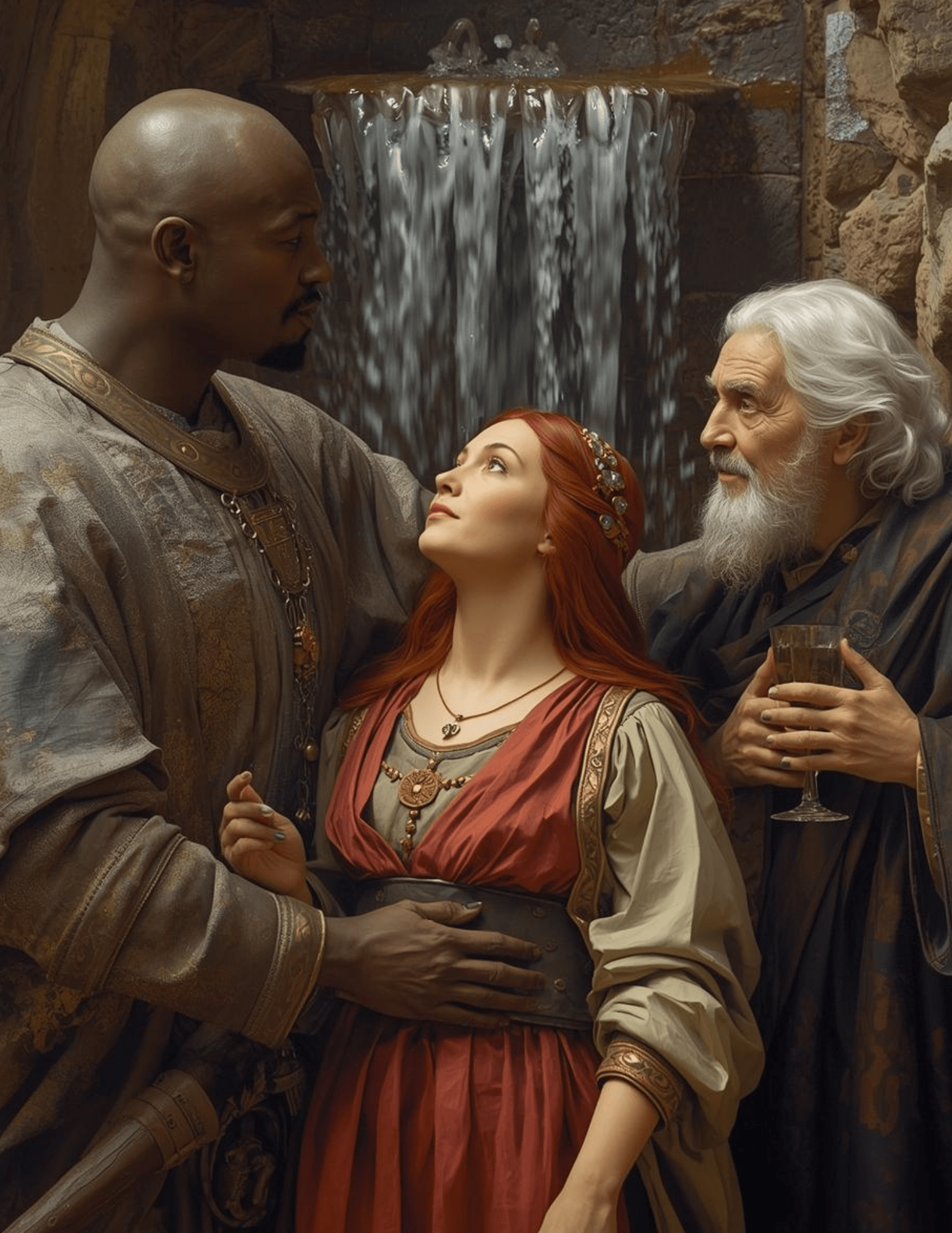
At the well in Samaria, the water was not a fountain. The water waited — deep, silent, and filtered by rock and soil — just as it had for generations.
Women came to draw water from this well, filling their water pots. Men filled larger containers to water their flocks.
And about 30 generations before Jesus began speaking, the Teacher of Israel, whom the Egyptians called Moses, came to a well in Midian. There, fleeing from Pharaoh, Moses defended Zipporah and her sisters from some shepherds who were harassing them.
In Samaria, a Teacher of Israel appears with a woman who has had five husbands and the one she is now with is not her husband. And he says to her:
If you knew the gift of God — And who it is who is asking you for a drink you would have asked him and he would have given you living water.
Everyone who drinks this water will be thirsty again. But whoever drinks the water I give him will never thirst. Indeed, the water I give him will become in him a fount of water springing up to eternal life.
Taking in this water and its promise the Woman — whom the Greeks call Photini and the Latins come to know as Sum Maria — goes into the city, leaving her water pot behind.
In the city of Capernaum, some thirty to forty miles north of Jacob’s Well — where the Woman left her water pot behind — there stood a synagogue of black basalt.
Here within this formidable black rock structure, people had come searching for Jesus after they had witnessed another astonishing sign. Before coming to this gathering place — where both women and men met for instruction, for teaching, and for fellowship — many had been on a grassy hillside near Bethsaida.
There, like a good homemaker, Jesus had fed five thousand with five loaves and two fish.
And as news of this spread, those the who caught it on the wind began to stir and wonder who this person might be.
Was this the Prophet foretold in the Psalms and the Prophets — perhaps recalling how Elisha had once fed a hundred with twenty loaves?
Those who had crossed over the water began telling others how the wind had risen, stirring the sea. Those in the first boat — experienced lead hands —were tossed about and sorely afraid.
And then, in the midst of the tempest, they saw Jesus walking upon the water, reaching out to them, saying:
It is I. Do not be afraid.
Then they welcomed Jesus on board, and together in the same boat, they reached the shore where they were heading.
On shore, those of the same boat found their way to the house of assembly hewn from black basalt.
There they found Jesus instructing the people in the ways of the Rabbis, and some began to call Jesus Rabbi. Yet others who came in different boats were not seeking wisdom or prophecy, but bread to fill their stomachs.
For having eaten and been filled, they later crossed over amazed to find the one who had fed the five thousand. They asked:
Rabbi, when did you get here?
For they had eaten the bread and had watched as the others — all in the same boat —departed first — without Jesus.
And Jesus said:
Do not work for food that perishes …but for food that endures to eternal life — the food the Son of Man will give you. For on this one God the Father has set His seal.
And when they asked what they must do, Jesus replied:
The work of God is this — to believe in the One He has sent.
Yet they still asked for a sign, recalling the manna given in the wilderness to the Teacher of Israel — whom the Egyptians called Moses. And so the teaching of Jesus turned again:
It was not Moses who gave the bread from heaven, but the Father who gives the true bread — the bread that comes down from heaven and gives life to the world.
Yet even this was not spoken for all to grasp — but for those who have ears to hear. For when the Feast of Tabernacles drew near, Jesus sent the disciples ahead to speak openly.
But Jesus did not go with them — until, in the midst of the feast, Jesus stood up and began to teach in the temple courts.
And the people were astonished, saying:
How does this man know such things, having never studied?
And others said:
Have the rulers truly recognized that this is the Christ? But we know where this man is from. When the Christ comes, no one will know where He is from.
Then Jesus, still teaching in the temple courts, cried out:
You know Me, and you know where I am from. I have not come of My own accord, but He who sent Me is true. You do not know Him, but I know Him, because I am from Him and He sent Me.
Though some sought to seize Him, no hand was laid upon Him, for His hour had not yet come. And many among the crowd believed in Him, and said:
When the Christ comes, will He perform more signs than this man?
When the Pharisees heard the crowd whispering these things, they sent officers to arrest Him.
So Jesus said:
I am with you only a little while longer, and then I am going to the One who sent Me. You will look for Me, but you will not find Me; and where I am, you cannot come.
At this, the Jews said to one another:
Where does He intend to go that we will not find Him? Will He go to the Jews dispersed among the Greeks — and teach the Greeks?
These questions hung in the air. And then —
On the last and greatest day of the feast, Jesus stood up and cried out in a loud voice:
If anyone is thirsty, let him come to Me and drink. Whoever believes in Me, as the Scripture has said: “Streams of living water will flow from within him.”
He was speaking about the Spirit, whom those who believed in Him were later to receive. For the Spirit had not yet been given, because Jesus had not yet been glorified.
For the Hour had not yet come —just as a man and a woman, when wed, become one flesh — in that union, are glorified.
____________________________________
This is the thirteenth in a series of Epiphany reflections paving the way for the Cross.
Now in Easter Week, the next Epiphany reflection turns to the moment when the Woman caught in the act of adultery is brought to trial — and when the Light revealed as the Word is watched over and accomplished.
If you would like to receive the next reflection, be sure to subscribe.
Discover more from Linda Vogt Turner
Subscribe to get the latest posts sent to your email.
 Linda Vogt Turner