
Who among you can cast the First Stone? This is the question at the heart of Christ’s Mission.

This is the question that Jesus asked when the Woman caught in Adultery was brought forward — after Nicodemus, the Teacher of Israel, had asked:
“Does our law convict a man without first hearing from him to determine what he has done?”
As the scribes and the pharisees questioned Jesus — the one being questioned bent down and wrote on the ground. And the other, standing straight, said: “Let him who is without sin among you be the first to cast a stone at her.”
This question sounds as if whoever casts the first stone should be someone who is perhaps like Nathanael — someone who Rabbi Jesus declared:
“Here is a true Israelite, in whom there is no deceit.”
Upon hearing this, Nathanael asks:
“How do You know me?”
Rabbi Jesus replies:
“Before Philip called you, I saw you under the fig tree.”
“Rabbi,” Nathanael answered,
“You are the Son of God! You are the King of Israel!”
Nathanael is the first to declare Jesus as the Son of God, the King of Israel.
For when Jesus says, “I saw you under the fig tree,” the fig tree calls forth the memory of fig leaves — how they first hid man from God.
And in the garden, the LORD God called out to the man,
“Where are you?”
In John Two, after Nathanael recognizes Jesus as the Son of God the Father, a wedding in Cana comes into view. Here the Bridegroom is called aside — although neither he nor the Bride are explicitly identified.
In John Three, Jesus and the Man Jesus called Nicodemus, the Teacher of Israel —meet at night.
At the end of John Three, the Rabbi, the Teacher of Israel known to his disciples as John says:
“A man can receive only what is given him from heaven.
You yourselves can testify that I said, ‘I am not the Christ, but am sent ahead of Him.’
The bride belongs to the bridegroom. The friend [the philos] of the bridegroom stands and listens for him, and is overjoyed to hear the bridegroom’s voice. That joy is mine, and it is now complete. He must increase; I must decrease.
The one who is from the earth belongs to the earth and speaks as one from the earth. The One who comes from heaven is above all.
The Father loves the Son and has placed all things in His hands.”
And Simon Bar Jonah has been cast in the role of the First Stone, the Foundation Stone — the Father — of a born again kingdom of God.
According to Luke’s Gospel,
Jesus predicted Simon’s denial saying:
“Simon, Simon, Satan has asked to sift all of you like wheat.
But I have prayed for you, Simon, that your faith will not fail. And when you have turned back, strengthen your brothers.”…
“Lord,” said Peter, “I am ready to go with You even to prison and to death.”
But Jesus replied, “I tell you, Peter, [the alektor] will not crow today until you have denied three times that you know Me.”
In John, upon the Resurrection, it is Simon and John who are the first to enter the tomb — John arriving ahead.
But they still did not understand that — from Scripture — Jesus had to rise — from the dead.
So the Woman Jesus called to go and sin no more with sins of scarlet washed as white as snow — clings to her Lord, with the hope of the ascension.
She goes and begins to tell the brothers of the Rabboni, Jesus the Forerunner — that he must ascend to her Father.
Later, by the Sea of Tiberias, [godly sights] Jesus again revealed Himself to the disciples. He made Himself known in this way: Simon Peter, Thomas called Didymus, Nathanael from Cana in Galilee —and the sons of Zebedee — two other disciples — were together.
And Simon announced:
“I am going fishing.”
“We will go with you,” they said.
So all — of Simon — being sifted like wheat — together with the sons of Zebedee — went out, but caught nothing that night.
Without the light — Simon caught nothing.
Had Simon forgotten or was he struggling to remember the Hebrew tongue — how in the beginning, Ruah the feminine Hebrew word for Spirit hovered over the deep dark waters?
Was he also struggling to recall the word he heard Jesus speak in Aramaic — naming the Twelve?
For of the Twelve appointed to preach were:
James son of Zebedee and his brother John (whom He named Boanerges, meaning “Sons of Thunder”)…
So early in the morning, Jesus stood on the shore, but the disciples did not recognize that it was Jesus.
So He called out to them, “Children, do you have any fish?”
“No,” they answered.
He told them, “Cast the net on the right side of the boat, and you will find some.” So they cast it there, and they were unable to haul it in because of the great number of the fish.
Then the disciple whom Jesus loved said to Peter, “It is the Lord!”
As soon as Simon Peter heard that it was the Lord, he put on his outer garment (for he had removed it) and jumped into the sea.
The other disciples came ashore in the boat. They dragged in —their net —full of fish, for they were not far from land, only about a hundred yards.
When they landed, they saw a charcoal fire there with fish on it, and some bread.
Jesus told them, “Bring some of the fish you have just caught.”
— So Simon Peter went aboard and dragged the net ashore. It was full of — large fish — 153.
But even with so many —
the net was not torn.
“Come, have breakfast,”
Jesus said to them.
None of the disciples dared to ask Him,
“Who are You?”
They knew it was the Lord.
Jesus came and took the bread and gave it to them, and He did the same with the fish.
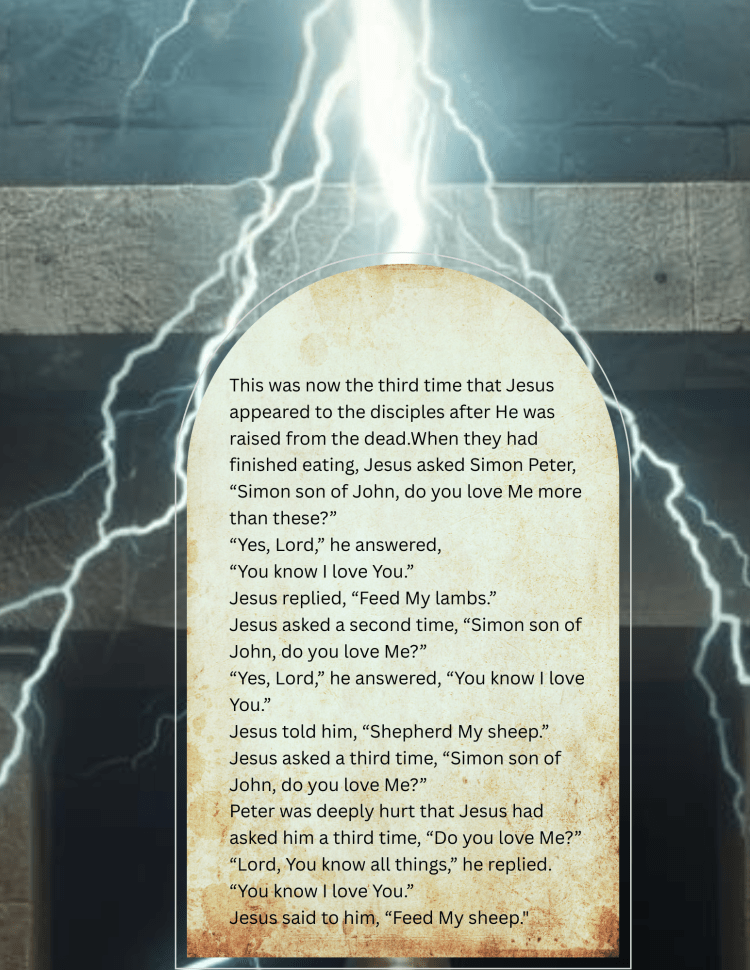
For it was John, the forerunner, of Simon Peter who said:
” A man can receive only what is given him from heaven. You yourselves can testify that I said, ‘ I am not the Christ, but am sent ahead of Him.
The bride belongs to the bridegroom.
The friend of the bridegroom stands and listens for him, and is overjoyed to hear the bridegroom’s voice. ‘”
The stone is cast — and the Fish is caught — as the rooster [the alektōr] calls all to turn back and honour the Father and the Mother.
For a man can receive only what is given him from heaven.
________________________________________
This is the seventeenth in a series of Epiphany reflections, paving the way for the Cross and the Easter season.
The next Epiphany reflection turns to the Ascension of Jesus — and the promise of His return, just as the men of Galilee saw Him go into heaven.
If you want to receive the next reflection, be sure to subscribe.
Discover more from Linda Vogt Turner
Subscribe to get the latest posts sent to your email.

